Does 0.005% Finasteride Work?
0.005% topical finasteride showed regrowth in a 16-month study with no serum hormonal shifts. See what to expect, safety notes, and who it’s best for.
0.005% topical finasteride showed regrowth in a 16-month study with no serum hormonal shifts. See what to expect, safety notes, and who it’s best for.

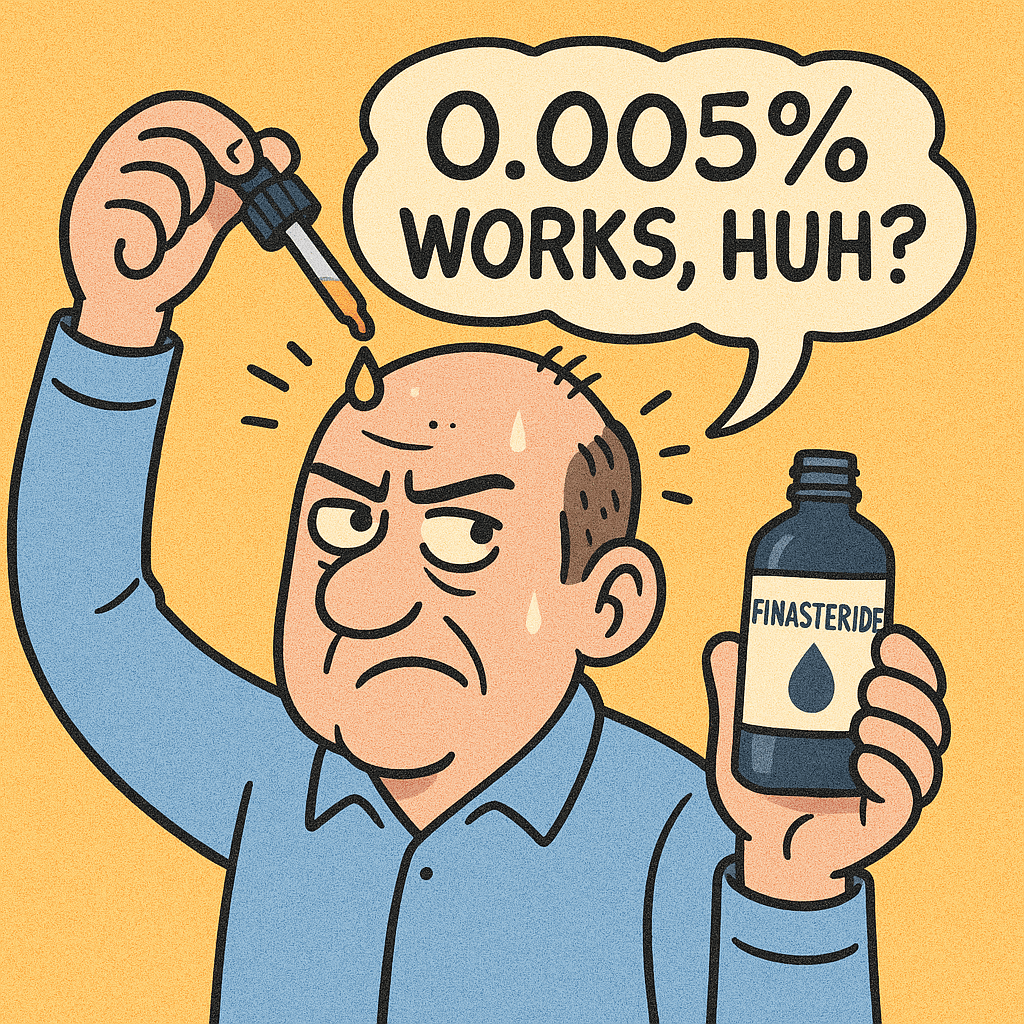
Yes, there’s published evidence that 0.005% topical finasteride can improve hair outcomes with minimal measurable systemic effects, but gains are slow and modest, and the data set is small compared to higher-dose topicals (e.g., 0.25%).
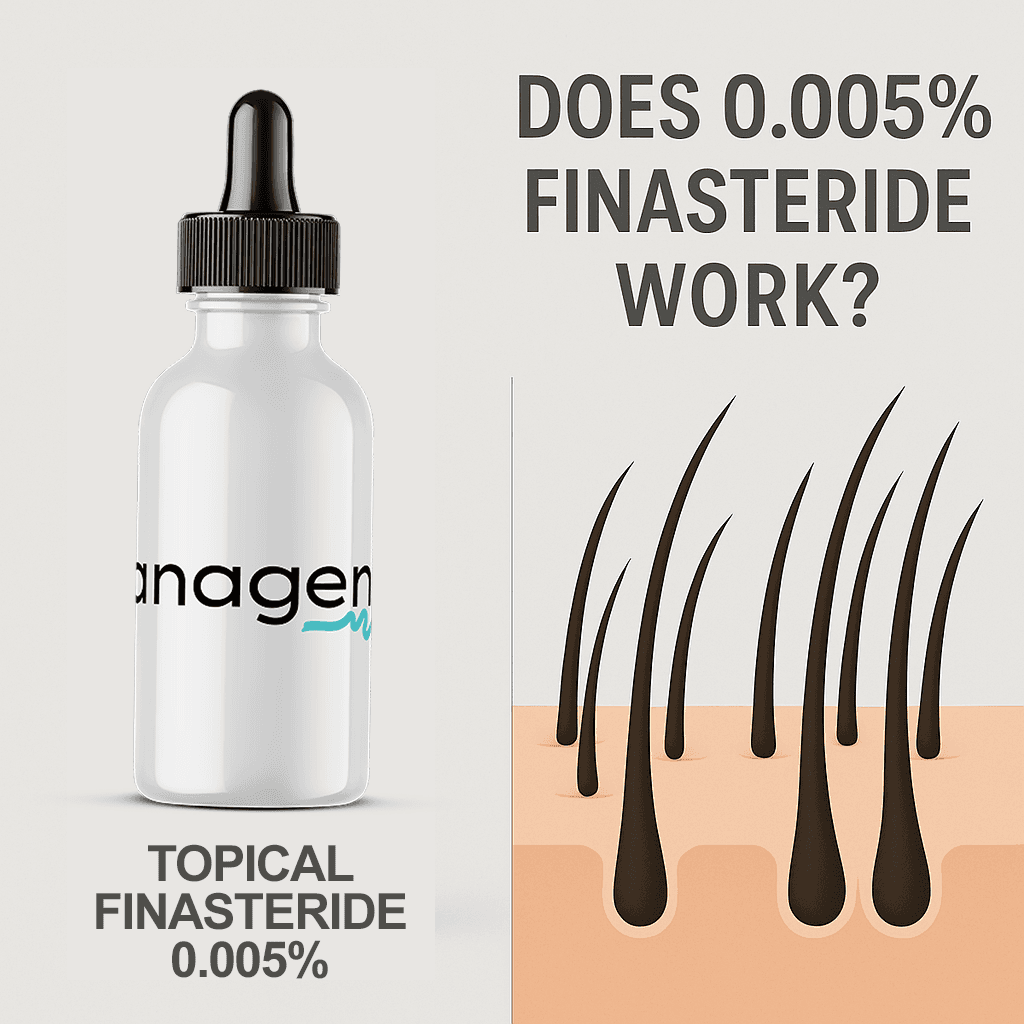
The 1997 Italian Study at a Glance (0.005%)
Design: Single-blind, placebo-controlled; 52 adults (28 men, 24 women) with androgenetic alopecia. Compared 0.005% finasteride solution (1 mL twice daily) vs. vehicle for 16 months. [Taylor & Francis Online]
Hormones & safety: No measurable changes in serum DHT, total or free testosterone across serial checks; no adverse events reported.
Efficacy:
Limitations: These endpoints (wash tests, visual scoring, investigator impressions) are subjective and less precise than modern imaging or hair-count methods. Still, they provide useful, if imperfect, evidence that even very low-dose topical finasteride may help reduce shedding and promote regrowth.
People who want topical finasteride but prefer ultra-low systemic exposure (based on 1997 serum data). Taylor & Francis Online
Those comfortable with a slow-gain profile (months to see visible change; year-scale for best cosmetic impact). Taylor & Francis Online
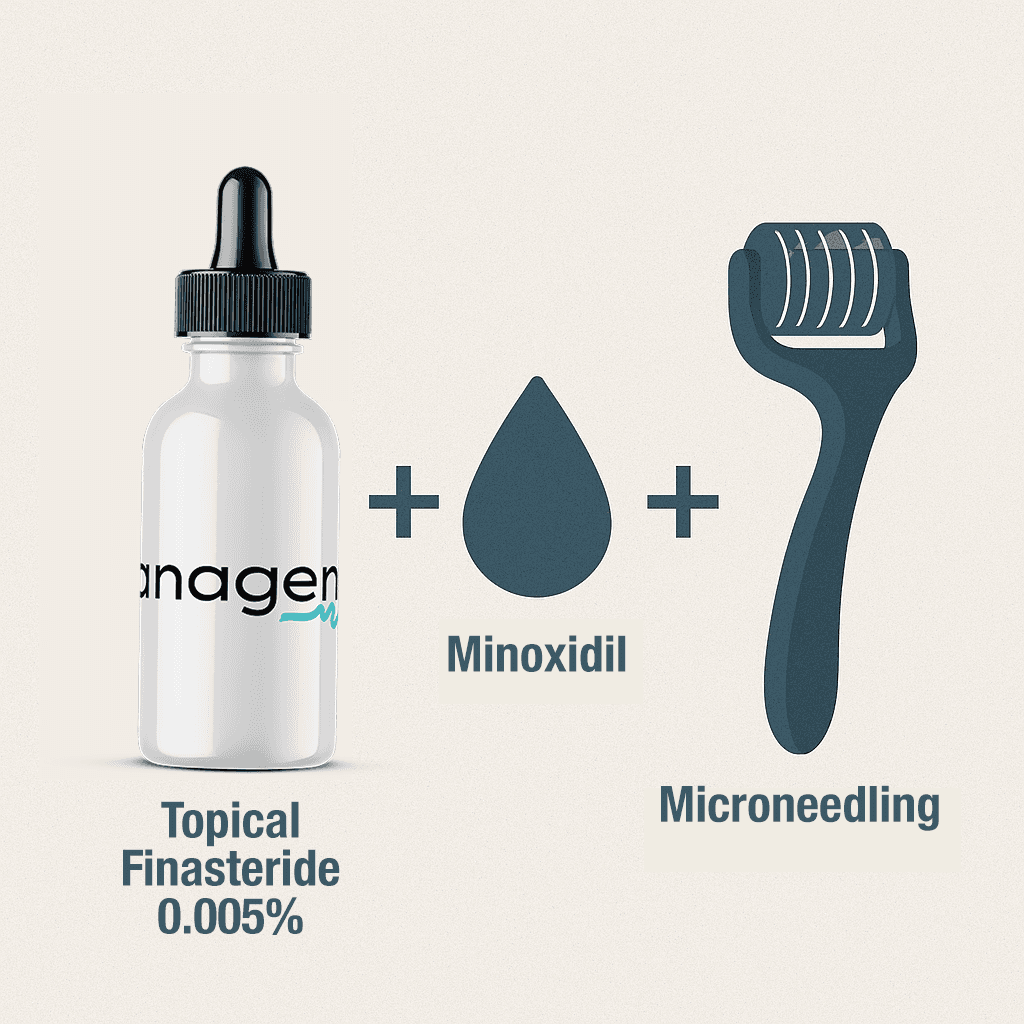
Users planning combination therapy (e.g., add minoxidil, consider microneedling) to amplify results while staying low-dose on finasteride. (Modern evidence supports topical finasteride ± minoxidil at higher strengths; extrapolation to 0.005% is reasonable but less studied.)
That is why we offer it both as a solo treatment and combination treatment on anagen.xyz.
The 1997 Italian 0.005% study reported no measurable changes in serum DHT or testosterone and no adverse effects over 16 months. [Taylor & Francis Online]
When you plot DHT reductions across multiple finasteride dosages, a plateau effect emerges. DHT suppression increases steeply at very low doses, but then flattens out — meaning higher doses reduce serum DHT much more systemically without proportionally improving scalp benefit.
This is why low-dose topical finasteride (like 0.005%) is attractive: it sits on the steep, efficient part of the curve, where you get local scalp action with much less systemic DHT reduction than higher topical or oral doses. [PMC+1]
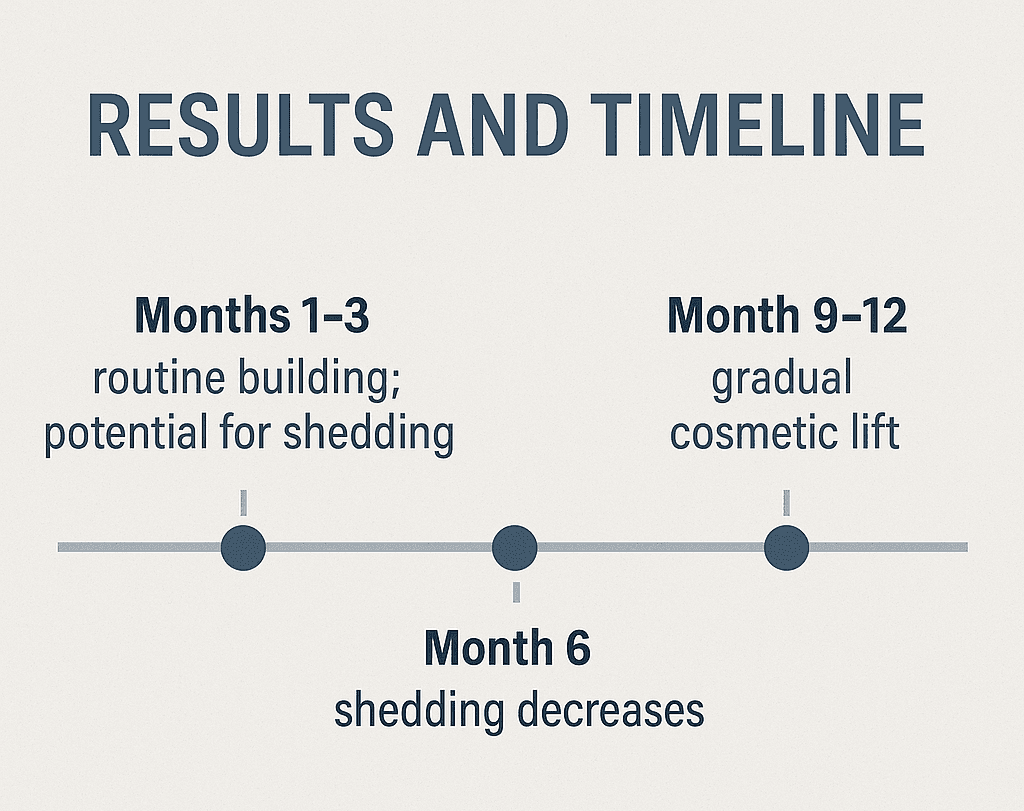
Does 0.005% topical finasteride work? Yes, but the effects are gradual. Clinical evidence shows it can reduce shedding and improve density with very little systemic DHT suppression, making it a lower-risk, slower-gain option.
For faster or more robust average results, stronger evidence exists for 0.25% topical finasteride, which still produces less systemic exposure than oral finasteride. Many people use low-dose finasteride alongside minoxidil and track progress with photos or trichoscopy to maximize outcomes.
Is 0.005% finasteride strong enough to work?
Evidence says yes, but gains are modest and slow compared with higher-dose topicals. Expect meaningful assessment at 6–12+ months. Taylor & Francis Online
Does 0.005% change hormones?
In the 1997 study, no measurable changes in serum DHT or testosterone were detected. Modern higher-dose topicals also show lower systemic exposure than oral. Taylor & Francis Online+1
How does 0.005% compare to 0.25%? 0.25% topical finasteride has stronger clinical trial data, including randomized controlled trials showing significant increases in hair counts compared to placebo, while still keeping systemic exposure lower than oral finasteride.
By contrast, 0.005% relies on smaller, older studies with less robust endpoints. The evidence suggests it can work, but the gains are generally more modest. Its main advantage is a very favorable safety profile, since systemic DHT suppression is minimal. [PMC]
Can I combine 0.005% with minoxidil?
Common in practice; RCT data support topical finasteride ± minoxidil at higher strengths. Combination may help stimulate additional regrowth if you prefer ultra-low finasteride dosing. Wiley Online Library
Who should avoid self-managing hair loss?
Anyone with rapid shedding, scarring signs, pain/inflammation, patchy loss, or post-partum/illness triggers—connect with a clinician.
0.005% topical finasteride showed regrowth in a 16-month study with no serum hormonal shifts. See what to expect, safety notes, and who it’s best for.

Yes, there’s published evidence that 0.005% topical finasteride can improve hair outcomes with minimal measurable systemic effects, but gains are slow and modest, and the data set is small compared to higher-dose topicals (e.g., 0.25%).
The 1997 Italian Study at a Glance (0.005%)
Design: Single-blind, placebo-controlled; 52 adults (28 men, 24 women) with androgenetic alopecia. Compared 0.005% finasteride solution (1 mL twice daily) vs. vehicle for 16 months. [Taylor & Francis Online]
Hormones & safety: No measurable changes in serum DHT, total or free testosterone across serial checks; no adverse events reported.
Efficacy:
Limitations: These endpoints (wash tests, visual scoring, investigator impressions) are subjective and less precise than modern imaging or hair-count methods. Still, they provide useful, if imperfect, evidence that even very low-dose topical finasteride may help reduce shedding and promote regrowth.
People who want topical finasteride but prefer ultra-low systemic exposure (based on 1997 serum data). Taylor & Francis Online
Those comfortable with a slow-gain profile (months to see visible change; year-scale for best cosmetic impact). Taylor & Francis Online
Users planning combination therapy (e.g., add minoxidil, consider microneedling) to amplify results while staying low-dose on finasteride. (Modern evidence supports topical finasteride ± minoxidil at higher strengths; extrapolation to 0.005% is reasonable but less studied.)
That is why we offer it both as a solo treatment and combination treatment on anagen.xyz.
The 1997 Italian 0.005% study reported no measurable changes in serum DHT or testosterone and no adverse effects over 16 months. [Taylor & Francis Online]
When you plot DHT reductions across multiple finasteride dosages, a plateau effect emerges. DHT suppression increases steeply at very low doses, but then flattens out — meaning higher doses reduce serum DHT much more systemically without proportionally improving scalp benefit.
This is why low-dose topical finasteride (like 0.005%) is attractive: it sits on the steep, efficient part of the curve, where you get local scalp action with much less systemic DHT reduction than higher topical or oral doses. [PMC+1]
Does 0.005% topical finasteride work? Yes, but the effects are gradual. Clinical evidence shows it can reduce shedding and improve density with very little systemic DHT suppression, making it a lower-risk, slower-gain option.
For faster or more robust average results, stronger evidence exists for 0.25% topical finasteride, which still produces less systemic exposure than oral finasteride. Many people use low-dose finasteride alongside minoxidil and track progress with photos or trichoscopy to maximize outcomes.
Is 0.005% finasteride strong enough to work?
Evidence says yes, but gains are modest and slow compared with higher-dose topicals. Expect meaningful assessment at 6–12+ months. Taylor & Francis Online
Does 0.005% change hormones?
In the 1997 study, no measurable changes in serum DHT or testosterone were detected. Modern higher-dose topicals also show lower systemic exposure than oral. Taylor & Francis Online+1
How does 0.005% compare to 0.25%? 0.25% topical finasteride has stronger clinical trial data, including randomized controlled trials showing significant increases in hair counts compared to placebo, while still keeping systemic exposure lower than oral finasteride.
By contrast, 0.005% relies on smaller, older studies with less robust endpoints. The evidence suggests it can work, but the gains are generally more modest. Its main advantage is a very favorable safety profile, since systemic DHT suppression is minimal. [PMC]
Can I combine 0.005% with minoxidil?
Common in practice; RCT data support topical finasteride ± minoxidil at higher strengths. Combination may help stimulate additional regrowth if you prefer ultra-low finasteride dosing. Wiley Online Library
Who should avoid self-managing hair loss?
Anyone with rapid shedding, scarring signs, pain/inflammation, patchy loss, or post-partum/illness triggers—connect with a clinician.