Ketoconazole is an antifungal drug. Taken by mouth, a single dose lowers testosterone for several hours. As a 2% shampoo, it has been linked to thicker hair shafts in small studies of men with pattern hair loss.
The short answer: Ketoconazole 2% shampoo has been linked to slightly thicker hair in small studies of men, but the evidence is thin. In a widely cited 1998 study, hair density rose 18% in 4 men using the shampoo for six months and 11% in 4 men using 2% minoxidil lotion (Piérard-Franchimont et al. 1998). We found no placebo-controlled randomized trial in pattern hair loss, so what it adds to finasteride or minoxidil is unknown. In the one small test of adding it to finasteride, the gain was not shown to be significant.
Does ketoconazole shampoo really thicken hair?
The best-known evidence is a 1998 Belgian paper that reports two studies (Piérard-Franchimont et al. 1998). In the first, 27 men with grade III vertex balding used 2% ketoconazole shampoo 2 to 4 times a week for 21 months, and 12 used an unmedicated shampoo. None had had dandruff or seborrheic dermatitis in the previous six months.
Their measure, a "pilary index" combining the share of growing (anagen) hairs with shaft diameter, rose on ketoconazole from about month 6 and levelled off around month 15. On the plain shampoo it fell slowly. The paper doesn't describe randomization or blinding, and it shows the index only in a figure.
The second study is the 4-men-per-group minoxidil comparison. Hair density went from 250 to 296 hairs per cm² on the shampoo, and from 276 to 306 on minoxidil lotion applied once a day. Median hair shaft diameter rose 7% in both groups. Two of the four authors listed Janssen and Johnson & Johnson affiliations, and the authors called for a larger controlled study.
A later randomized study from the same group tested three 1% shampoos in 150 men with dandruff and extra shedding linked to pattern hair loss (Piérard-Franchimont et al. 2002). They used ketoconazole, piroctone olamine or zinc pyrithione 2 to 3 times a week for six months. Hair density didn't change in any group. On ketoconazole, shedding fell 17.3% and shaft diameter rose 5.4%, close to piroctone olamine's 16.5% and 7.7%. There was no placebo shampoo.
The remaining human data are smaller. In an open randomized study of 100 men, 10 took finasteride with 2% ketoconazole shampoo (Khandpur et al. 2002). They ranked ahead of the men on finasteride alone, though the group was small and the gap was not shown to be significant. No group used ketoconazole by itself. In a Japanese case series, six men applied a 2% ketoconazole lotion almost daily. Two had marked regrowth, one a slight increase, and three didn't improve significantly (Inui and Itami 2007).
In mice, 2% ketoconazole in ethanol regrew hair over 61% of a clipped area by day 21, significantly more than ethanol alone (p = 0.006, 10 mice per group; Jiang et al. 2005). But the coat hair in these mouse models doesn't respond to androgens (Fields et al. 2020), so the result says little about DHT.
A 2020 systematic review covered seven studies, five of them in people (318 participants). It called topical ketoconazole "a promising adjunctive or alternative therapy" and concluded that "randomized controlled trials are needed" (Fields et al. 2020). We searched PubMed and Europe PMC on 15 November 2026 and found no later randomized trial.
Is ketoconazole shampoo as good as minoxidil?
No properly sized trial has compared the two. The comparisons that exist either favour minoxidil or are too small to tell them apart. Topical minoxidil and oral finasteride are the FDA-approved first-line treatments for pattern hair loss (Fields et al. 2020). Ketoconazole shampoo is approved in the US at 2% for tinea versicolor and at 1% for dandruff (Cosette Pharmaceuticals 2024; Kramer Laboratories 2026).
The 1998 near-tie can't establish equivalence. It had 4 men per group, and they used minoxidil once a day, half the twice-daily schedule a later trial used for 2% minoxidil (Khandpur et al. 2002).
In a randomized study of 40 women, hair growth improved significantly by month 4 on 2% minoxidil, and not until month 6 on a 2% ketoconazole preparation (El-Garf et al. 2019). Satisfaction was similar in both groups, and 10% of the ketoconazole group had side effects. In mice, 5% minoxidil scored 39.53 for regrowth against 15.98 for 2% ketoconazole (Aldhalimi et al. 2014). Our rosemary oil vs minoxidil post looks at another small trial against 2% minoxidil.
Guideline panels treat ketoconazole as optional. Japan's 2017 guideline graded topical ketoconazole C1, "permissible", on "weak evidence" in men (Manabe et al. 2018). A 2025 Canadian panel of 11 physicians rated ketoconazole shampoo "recommended with near consensus", one level below topical and oral minoxidil and oral finasteride (Landells et al. 2025).
Anagen's hair loss treatment tier list puts ketoconazole in C tier, below finasteride, dutasteride and minoxidil in A tier. Our reading is that the hair studies are small and mixed, and none is big enough to show what ketoconazole adds. Its best-supported use is dandruff. Anagen sells a prescription 2% ketoconazole shampoo. Using it for hair loss is off-label, and a clinician decides whether it fits you.
Does ketoconazole shampoo block DHT?
We found no study that measured DHT in the scalp or blood of people using ketoconazole shampoo, so there's no direct evidence that it does. The evidence for its anti-androgen effects comes from oral doses and cell experiments.
Taken by mouth, ketoconazole inhibits CYP17A1, an enzyme upstream of testosterone. A 2009 prostate cancer trial used it that way at 400 mg three times a day, adding dutasteride to block 5-alpha reductase, the enzyme that makes DHT (Taplin et al. 2009). Long-term use at 200 mg once a day lowered testosterone only minimally (Santen et al. 1983). At 800 to 1,200 mg a day the blockade was prolonged, and some men had impotence and lower libido (Pont et al. 1984). For what DHT does inside the follicle, see what DHT actually does downstream.
In cell experiments, ketoconazole also acts on the androgen receptor. In cultured human skin fibroblasts it competed with androgen for the receptor, but only at a concentration the author judged "not likely to be achieved in vivo, at least in plasma" (Eil 1992). In cells engineered to carry the receptor and stimulated with a synthetic androgen, 10 and 20 µg/mL of ketoconazole cut receptor activity to 67.5% and 49.9% of the androgen-only level (Inui and Itami 2007). Those authors noted that ketoconazole would have to penetrate deep into the dermal papilla to do this in people.
On the US label, ketoconazole wasn't detected in plasma in 39 patients who shampooed 4 to 10 times a week for six months. Nor was it detected in 33 who shampooed 2 to 3 times a week for 3 to 26 months (Cosette Pharmaceuticals 2024). The label gives no detection limit for the assay. Any anti-androgen effect of the shampoo would have to happen locally in the scalp, and none has been measured.
How does ketoconazole shampoo work on the scalp?
Mainly as an antifungal against Malassezia, the yeasts linked to dandruff and seborrheic dermatitis. In fungi, ketoconazole is thought to block the step that turns lanosterol into ergosterol, a major part of the fungal cell membrane (Pont et al. 1982). Malassezia is generally agreed to be a major contributor to dandruff (Piérard-Franchimont et al. 2002). The US label for the 2% shampoo is more cautious. It calls the link between reducing the yeast and improving dandruff "postulated, but not proven" (Cosette Pharmaceuticals 2024).
For dandruff, the evidence is better. In a multicentre trial of 575 people with moderate to severe dandruff or seborrheic dermatitis, 88% had an excellent response to 2% shampoo twice a week for 2 to 4 weeks (Peter and Richarz-Barthauer 1995). That first phase had no control group. In the 6-month double-blind phase that followed in 312 responders, 19% of those using the shampoo weekly relapsed, against 47% on placebo shampoo. The 1% strength is sold over the counter as Nizoral Anti-Dandruff (Kramer Laboratories 2026), and the 2% needs a prescription.
Whether the yeast matters for hair loss is less clear. A 2026 review found that higher Malassezia levels in androgenetic alopecia have been reported less consistently than higher levels of the bacterium Cutibacterium acnes (Gupta et al. 2026). For other ingredients marketed for hair, see shampoos for hair loss.
Where did the idea of ketoconazole for hair loss come from?
From two separate lines of work: a side effect of the oral drug, and a scalp yeast theory tested in Belgium.
Ketoconazole was the first broad-spectrum oral antifungal approved by the FDA, in 1981 (Gupta et al. 2015). That same year, a report described 3 of 40 men who developed breast enlargement, or gynecomastia, while taking it (DeFelice et al. 1981).
A California group then measured testosterone. In male volunteers, a single 200, 400 or 600 mg dose made serum testosterone fall sharply, then return toward baseline 8 to 24 hours later (Pont et al. 1982). In a later randomized crossover trial in healthy men, one 200 mg dose cut testosterone to 60% below baseline within 4 to 8 hours (Santen et al. 1983). The pattern implicated the C17-20 lyase step of androgen synthesis. By 1984, ketoconazole at 400 mg every 8 hours was being tested for advanced prostate cancer (Trachtenberg and Pont 1984).
The yeast line began at the University of Liège, with the lymphoid infiltrate found around the upper part of balding follicles. Dermatologists there tested Janssen's 2% Nizoral shampoo on the theory that scalp yeast contributes to that inflammation (Piérard-Franchimont et al. 1998). A Japanese group proposed the anti-androgen explanation for the hair results in 2007 (Inui and Itami 2007).
Why was oral ketoconazole restricted, and is the shampoo different?
The FDA restricted the tablets on 26 July 2013 because they can cause severe liver injury, adrenal gland problems and harmful drug interactions. They're now reserved for serious fungal infections, such as blastomycosis, when other antifungals aren't available or tolerated. The FDA also said the topical forms, including shampoos, "have not been associated with liver damage, adrenal problems, or drug interactions" (FDA 2013).
The exposure is different. Tablets were usually taken at 200 to 400 mg once a day and reach measurable serum levels (Pont et al. 1982). The 2% shampoo is left on for 5 minutes, rinsed off, and wasn't detected in plasma in the label studies above (Cosette Pharmaceuticals 2024).
The side effects the label reports from trials are local. In 11 double-blind trials of 264 patients with dandruff or seborrheic dermatitis, an increase in normal hair loss and irritation occurred in less than 1%. Post-marketing reports include hair discoloration, abnormal hair texture, contact dermatitis and severe allergic reactions, including anaphylaxis.
What we don't know about ketoconazole for hair loss
The biggest gap is a placebo-controlled randomized trial in pattern hair loss that counts hairs. The studies so far tie ketoconazole shampoo to thicker hair shafts and less shedding in small groups of men. They don't show how much hair it adds.
The mechanism and the best regimen are also open. Ketoconazole could act through its antifungal effect, its reported anti-inflammatory activity or a local anti-androgen effect, and none has been measured in the balding scalp. We found no hair study comparing strengths or schedules. Our ketoconazole treatment science page lists the individual studies.
Frequently asked questions
Is Nizoral (1% ketoconazole) as good as 2% for hair loss?
We found no study comparing 1% and 2% ketoconazole for hair. Over-the-counter Nizoral Anti-Dandruff is 1% and labelled for dandruff. The one randomized hair study of 1% we found had no placebo group: shedding fell 17.3% and hair density didn't change. The density gains come from very small studies of 2%.
How often should I use ketoconazole shampoo for hair loss?
Hair studies used ketoconazole shampoo 2 to 4 times a week. The US label for the 2% shampoo, written for tinea versicolor, says to leave the lather on for 5 minutes before rinsing. No study has compared schedules for hair, so your prescriber sets the frequency, often with any dandruff in mind.
Can ketoconazole shampoo cause hair loss?
It's a listed side effect, but an uncommon one. In 11 double-blind trials of 264 people using 2% ketoconazole shampoo for dandruff or seborrheic dermatitis, an increase in normal hair loss and irritation occurred in fewer than 1%. Post-marketing reports also include abnormal hair texture and hair discoloration. Tell your clinician if your shedding increases.
Does ketoconazole shampoo lower DHT?
There's no direct evidence that it does. Taken by mouth, ketoconazole inhibits CYP17A1 and lowers testosterone for several hours after a single dose. In cultured cells it binds the androgen receptor. But the shampoo wasn't detected in users' plasma, and we found no study measuring scalp or blood DHT in shampoo users.
Can I use ketoconazole shampoo with minoxidil or finasteride?
We found no study of interactions between the shampoo and finasteride or minoxidil. Hair studies have tested ketoconazole shampoo alone and alongside finasteride. In the one combination test, 10 men on finasteride plus 2% ketoconazole shampoo ranked ahead of men on finasteride alone, though the group was small and the gap was not shown to be significant.
How long does ketoconazole shampoo take to work for hair?
In the 21-month Belgian study, a combined measure of growing hairs and hair thickness started rising after about 6 months of 2% shampoo and levelled off after about 15. In a small trial in women, improvement with 2% ketoconazole showed up at 6 months. Dandruff improved within 2 to 4 weeks in the uncontrolled first phase of a 575-person trial.
Ketoconazole at Anagen
Prescription 2% ketoconazole shampoo
Anagen sells a prescription 2% ketoconazole shampoo, prescribed after an online consultation. Using ketoconazole shampoo for hair loss is off-label, and the hair studies above are small, so a licensed clinician decides whether it is appropriate for you.
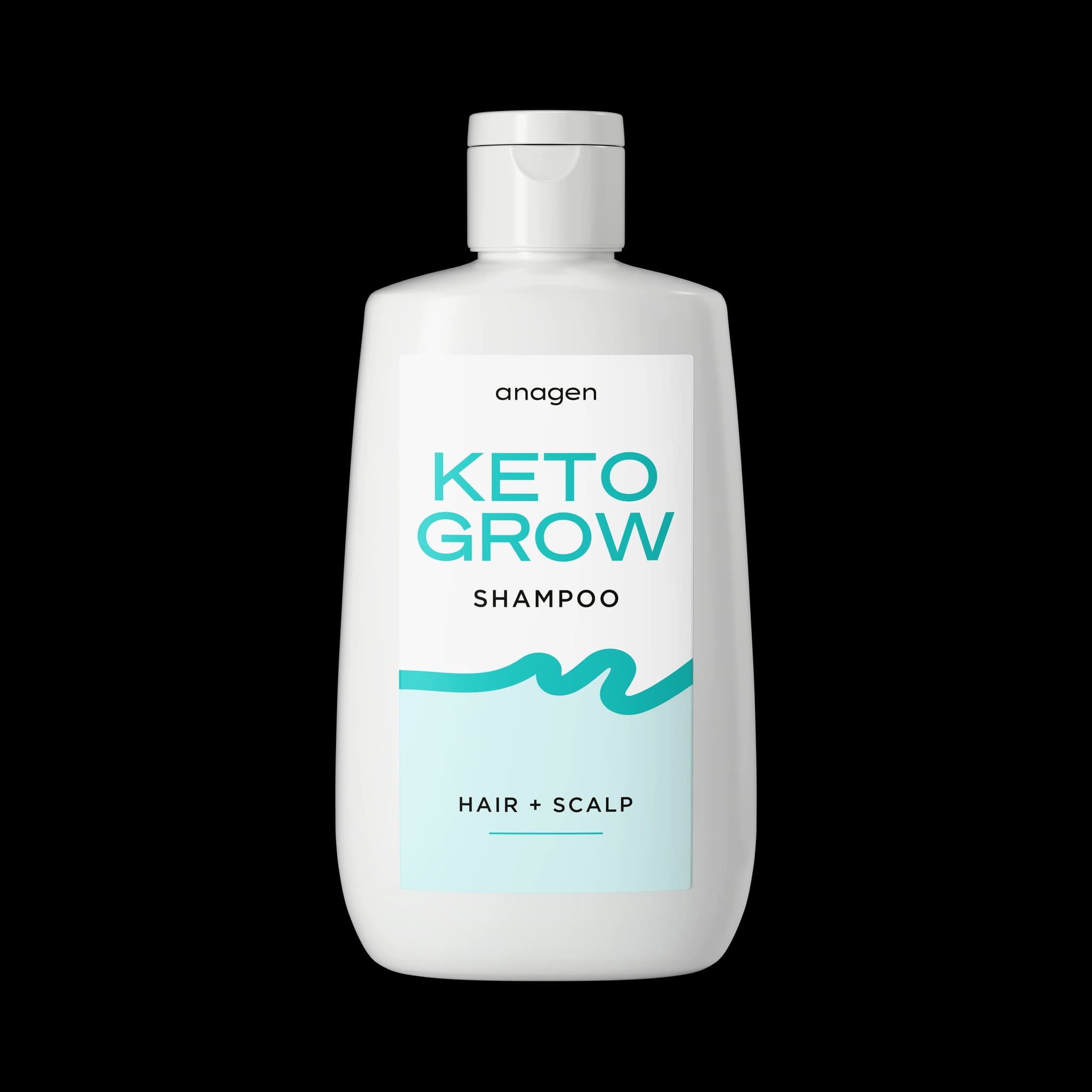
Prescription-strength 2% antifungal shampoo that controls the scalp yeast behind dandruff, used alongside finasteride or minoxidil.
- Ketoconazole
Starting at$22.49/ mo
ExploreReferences
- Piérard-Franchimont C, De Doncker P, Cauwenbergh G, Piérard GE. Ketoconazole shampoo: effect of long-term use in androgenic alopecia. Dermatology. 1998;196(4):474-477. DOI: 10.1159/000017954Cited in Introduction · Does ketoconazole shampoo really thicken hair? · Where did the idea of ketoconazole for hair loss come from?
- Gupta AK, Daigle D, Foley KA. Drug safety assessment of oral formulations of ketoconazole. Expert Opin Drug Saf. 2015;14(2):325-334. DOI: 10.1517/14740338.2015.983071Cited in Where did the idea of ketoconazole for hair loss come from?
- DeFelice R, Johnson DG, Galgiani JN. Gynecomastia with ketoconazole. Antimicrob Agents Chemother. 1981;19(6):1073-1074. DOI: 10.1128/AAC.19.6.1073Cited in Where did the idea of ketoconazole for hair loss come from?
- Pont A, Williams PL, Azhar S, et al. Ketoconazole blocks testosterone synthesis. Arch Intern Med. 1982;142(12):2137-2140. PMID: 6291475Cited in How does ketoconazole shampoo work on the scalp? · Where did the idea of ketoconazole for hair loss come from? · Why was oral ketoconazole restricted, and is the shampoo different?
- Santen RJ, Van den Bossche H, Symoens J, Brugmans J, DeCoster R. Site of action of low dose ketoconazole on androgen biosynthesis in men. J Clin Endocrinol Metab. 1983;57(4):732-736. DOI: 10.1210/jcem-57-4-732Cited in Does ketoconazole shampoo block DHT? · Where did the idea of ketoconazole for hair loss come from?
- Trachtenberg J, Pont A. Ketoconazole therapy for advanced prostate cancer. Lancet. 1984;2(8400):433-435. DOI: 10.1016/s0140-6736(84)92909-xCited in Where did the idea of ketoconazole for hair loss come from?
- Eil C. Ketoconazole binds to the human androgen receptor. Horm Metab Res. 1992;24(8):367-370. DOI: 10.1055/s-2007-1003337Cited in Does ketoconazole shampoo block DHT?
- Inui S, Itami S. Reversal of androgenetic alopecia by topical ketoconzole: relevance of anti-androgenic activity. J Dermatol Sci. 2007;45(1):66-68. DOI: 10.1016/j.jdermsci.2006.08.011Cited in Does ketoconazole shampoo really thicken hair? · Does ketoconazole shampoo block DHT? · Where did the idea of ketoconazole for hair loss come from?
- Piérard-Franchimont C, Goffin V, Henry F, Uhoda I, Braham C, Piérard GE. Nudging hair shedding by antidandruff shampoos. A comparison of 1% ketoconazole, 1% piroctone olamine and 1% zinc pyrithione formulations. Int J Cosmet Sci. 2002;24(5):249-256. DOI: 10.1046/j.1467-2494.2002.00145.xCited in Does ketoconazole shampoo really thicken hair? · How does ketoconazole shampoo work on the scalp?
- Cosette Pharmaceuticals, Inc. 2024. Ketoconazole shampoo, 2%: prescribing information (Rev. 07/2024; ANDA 076942). DailyMed. https://dailymed.nlm.nih.gov/dailymed/drugInfo.cfm?setid=2d7c8dd1-59b5-2645-e063-6394a90a5bdaCited in Is ketoconazole shampoo as good as minoxidil? · Does ketoconazole shampoo block DHT? · How does ketoconazole shampoo work on the scalp? · Why was oral ketoconazole restricted, and is the shampoo different?
- Peter RU, Richarz-Barthauer U. Successful treatment and prophylaxis of scalp seborrhoeic dermatitis and dandruff with 2% ketoconazole shampoo: results of a multicentre, double-blind, placebo-controlled trial. Br J Dermatol. 1995;132(3):441-445. DOI: 10.1111/j.1365-2133.1995.tb08680.xCited in How does ketoconazole shampoo work on the scalp?
- Kramer Laboratories, Inc. 2026. Nizoral Anti-Dandruff (ketoconazole 1%) shampoo: Drug Facts label (NDA 020310). DailyMed, version published 23 October 2026. https://dailymed.nlm.nih.gov/dailymed/drugInfo.cfm?setid=8dd6b2f1-f438-4be1-a6c4-4f6c8902dfb6Cited in Is ketoconazole shampoo as good as minoxidil? · How does ketoconazole shampoo work on the scalp?
- Gupta AK, Teasell EM, Liddy A, Economopoulos V. Scalp microbiome alterations in androgenetic alopecia: patterns and emerging mechanistic insights. Int J Dermatol. 2026;65(9):1828-1837. DOI: 10.1111/ijd.70365Cited in How does ketoconazole shampoo work on the scalp?
- Taplin ME, Regan MM, Ko YJ, et al. Phase II study of androgen synthesis inhibition with ketoconazole, hydrocortisone, and dutasteride in asymptomatic castration-resistant prostate cancer. Clin Cancer Res. 2009;15(22):7099-7105. DOI: 10.1158/1078-0432.CCR-09-1722Cited in Does ketoconazole shampoo block DHT?
- Pont A, Graybill JR, Craven PC, et al. High-dose ketoconazole therapy and adrenal and testicular function in humans. Arch Intern Med. 1984;144(11):2150-2153. PMID: 6093722Cited in Does ketoconazole shampoo block DHT?
- Khandpur S, Suman M, Reddy BS. Comparative efficacy of various treatment regimens for androgenetic alopecia in men. J Dermatol. 2002;29(8):489-498. DOI: 10.1111/j.1346-8138.2002.tb00314.xCited in Does ketoconazole shampoo really thicken hair? · Is ketoconazole shampoo as good as minoxidil?
- Jiang J, Tsuboi R, Kojima Y, Ogawa H. Topical application of ketoconazole stimulates hair growth in C3H/HeN mice. J Dermatol. 2005;32(4):243-247. DOI: 10.1111/j.1346-8138.2005.tb00756.xCited in Does ketoconazole shampoo really thicken hair?
- Aldhalimi MA, Hadi NR, Ghafil FA. Promotive effect of topical ketoconazole, minoxidil, and minoxidil with tretinoin on hair growth in male mice. ISRN Pharmacol. 2014;2014:575423. DOI: 10.1155/2014/575423Cited in Is ketoconazole shampoo as good as minoxidil?
- Fields JR, Vonu PM, Monir RL, Schoch JJ. Topical ketoconazole for the treatment of androgenetic alopecia: a systematic review. Dermatol Ther. 2020;33(1):e13202. DOI: 10.1111/dth.13202Cited in Does ketoconazole shampoo really thicken hair? (2) · Is ketoconazole shampoo as good as minoxidil?
- El-Garf A, Mohie M, Salah E. Trichogenic effect of topical ketoconazole versus minoxidil 2% in female pattern hair loss: a clinical and trichoscopic evaluation. Biomed Dermatol. 2019;3:8. DOI: 10.1186/s41702-019-0046-yCited in Is ketoconazole shampoo as good as minoxidil?
- Manabe M, Tsuboi R, Itami S, et al. Guidelines for the diagnosis and treatment of male-pattern and female-pattern hair loss, 2017 version. J Dermatol. 2018;45(9):1031-1043. DOI: 10.1111/1346-8138.14470Cited in Is ketoconazole shampoo as good as minoxidil?
- Landells I, Chow E, Gupta AK, et al. A Canadian consensus on androgenetic alopecia: approach and management. J Cutan Med Surg. 2025;29(5 Suppl):5S-14S. DOI: 10.1177/12034754251368849Cited in Is ketoconazole shampoo as good as minoxidil?
- FDA (US Food and Drug Administration). 2013. FDA limits usage of Nizoral (ketoconazole) oral tablets due to potentially fatal liver injury and risk of drug interactions and adrenal gland problems. Drug Safety Communication, 26 July. https://web.archive.org/web/20190424011702/https://www.fda.gov/Drugs/DrugSafety/ucm362415.htmCited in Why was oral ketoconazole restricted, and is the shampoo different?
This article is for educational purposes only and is not medical advice. Ketoconazole shampoo is not FDA approved for hair loss, and using it for that purpose is off-label; whether a prescription drug such as 2% ketoconazole shampoo is right for you is a decision for a licensed clinician who knows your history. Topical minoxidil and oral finasteride 1 mg are FDA approved for pattern hair loss, while oral minoxidil, dutasteride, topical finasteride and spironolactone are used off-label for it in the United States. Compounded products are not FDA approved. Oral ketoconazole tablets are restricted by the FDA to serious fungal infections when other treatments are not available or tolerated. Anagen sells a prescription 2% ketoconazole shampoo.