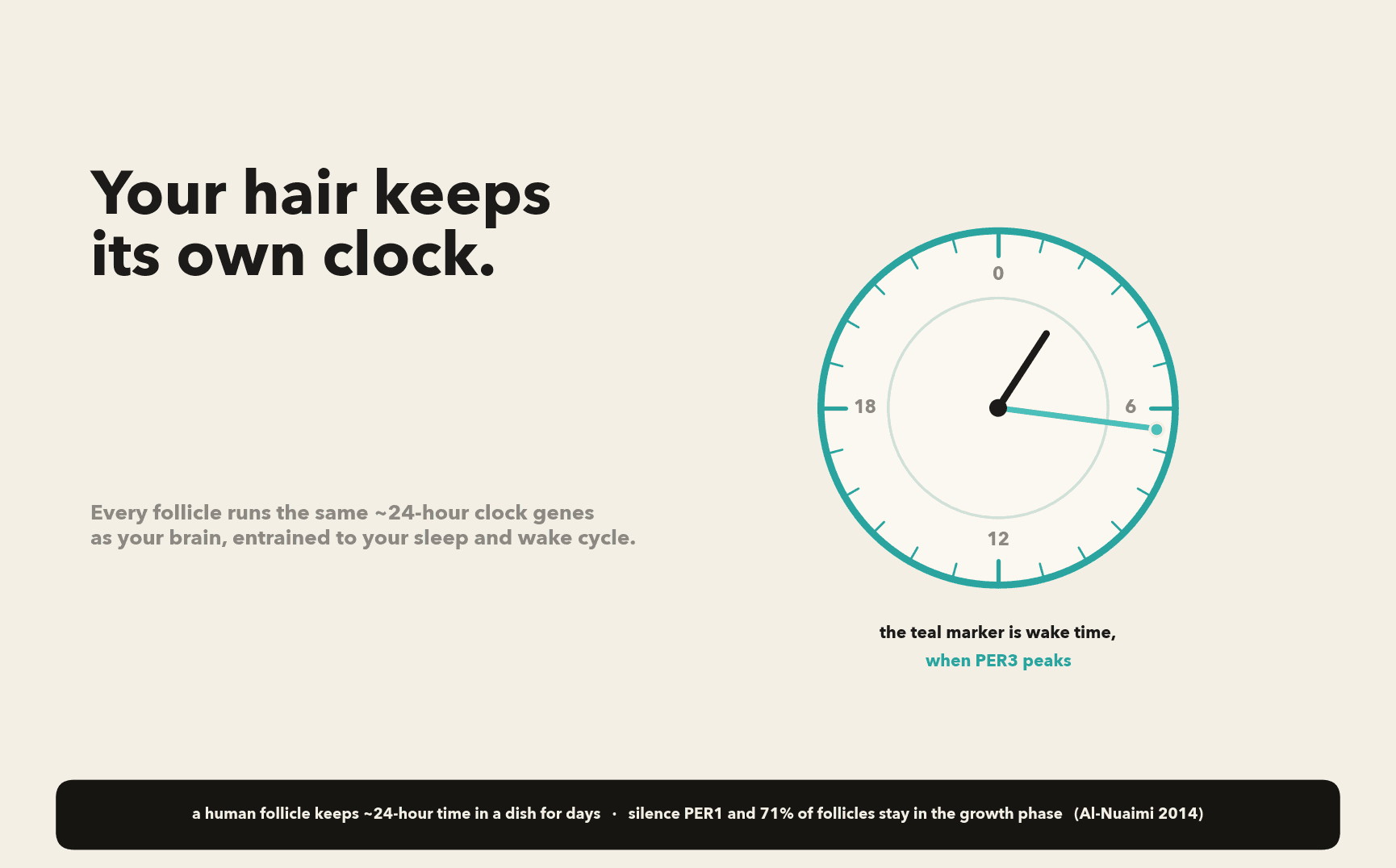
We talk about hormones, genetics, and blood flow when we talk about hair loss. We almost never talk about time. Yet one of the most striking findings in hair biology over the last two decades is that the hair follicle is, quite literally, a clock. It keeps 24-hour time, it is wired to your sleep and wake cycle, and the genes that run it help decide when a hair grows and when it stops.
This is a top-of-funnel science piece, not a treatment claim. We are going to be precise about what the evidence shows, because the honest version is more interesting than the hyped one, and because the hyped version ("bad sleep makes you bald") is not supported.
Your follicle runs the same clock as your brain
Deep in your brain sits the master clock, the suprachiasmatic nucleus, which keeps the body roughly aligned to the 24-hour day. But almost every tissue carries its own peripheral copy of the same molecular machinery: the genes BMAL1, CLOCK, PER (Period), and CRY (Cryptochrome), wired into a transcription-translation feedback loop that takes about a day to complete one cycle.
The hair follicle is no exception. When researchers measured clock-gene activity in human follicle cells, the same core genes were present and cycling (Akashi 2010; Al-Nuaimi 2014). Your hair is not a passive thread of keratin. At its root sit living cells running the same timekeeping program as the rest of you.
The clock is local, and you can prove it in a dish
Here is the experiment that makes the point. If you take a human scalp follicle, micro-dissect it out of the body, and keep it alive in organ culture, completely disconnected from the brain and nervous system, its clock genes keep cycling on a roughly 24-hour rhythm for days (Al-Nuaimi 2014).
A methodological note in the spirit of honesty: the researchers first gave the cultured follicles a brief synchronizing pulse (a standard step that lines up the individual cells so their combined signal does not cancel out), then watched the rhythm continue. The fact that the oscillation persisted well beyond that pulse, for more than four days in a repeated time course, is the evidence that the follicle is a genuine self-sustaining clock, not just reacting to the nudge.
The follicle does not borrow its sense of time from your head. It keeps its own.
A single plucked hair can read your body clock
If the follicle clock is synced to your personal rhythm, then a hair should be a window into your internal time. It is.
In one elegant study, researchers had volunteers pluck scalp and beard hairs at intervals around the clock and measured clock-gene expression in the root cells. The genes oscillated on a 24-hour cycle, and the timing matched each person's own sleep and wake pattern. PER3, one of the most reliable markers, peaked just around the time each subject woke up (Akashi 2010).
Then they did something useful with it. They looked at rotating shift workers and found a serious lag between the workers' molecular clock and their actual schedule, a measurable signature of circadian misalignment, readable from a hair. It is a beautiful demonstration that the follicle clock tracks your life.
One important caveat, because it is exactly where hype goes wrong: this study measured the timing of the clock, not the health of the hair. It does not show that shift work thins your hair. It shows that a plucked hair can tell you what time your body thinks it is.
These clock genes are not passengers. They gate the hair cycle.
So the follicle keeps time. Does that timing actually touch hair growth? Yes.
A hair follicle cycles between a long growth phase (anagen), a brief regression (catagen), and rest (telogen). The clock gene PER1 turns out to track that cycle: it stays quiet while a hair is growing, then climbs sharply as the follicle shifts into regression (Al-Nuaimi 2014).
That pattern suggested PER1 might be part of the signal that ends growth. So the researchers silenced it. Ninety-six hours later, 71 percent of the PER1-silenced follicles were still in the growth phase, versus just 4 percent of controls (Al-Nuaimi 2014). Silencing a clock gene kept hair growing longer. PER1, along with BMAL1, appears to be part of the molecular switch that tells a hair when to stop.
This is the "hopeful turn" of the story, but hold it lightly: this was gene silencing in cultured follicles, not a pill or a serum, and not a demonstration in living people.
The clock also decides when cells divide
The other thing a clock can do is schedule cell division, and the follicle uses it for exactly that. Two findings, both in mice, show how.
First, the reservoir. The follicle's stem-cell pool does not all wake up at once. At any given moment it is split into two camps sitting at opposite phases of the clock, some cells primed to activate and others held in reserve (Janich 2011). The clock is hedging, keeping some cells ready to go while protecting the rest. When that rhythm was knocked out in mice, the skin showed signs of premature ageing. Honest framing: this used a whole-body knockout, and losing that gene everywhere has its own ageing effects, so we should read this as an association, not proof that the follicle's own clock ages your skin.
Second, the speed. In the cells that actually build the hair shaft, the clock synchronizes when they enter mitosis, so hairs grow measurably faster at one point in the daily cycle than another (Plikus 2013). But here is the payoff that keeps this from being a "grow hair faster" gimmick: the total length of the finished hair was unchanged. The clock controls the timing of growth, not the amount.
So does sleep affect your hair?
Here is the honest read, stated plainly.
What is well supported: hair growth is not constant. It is rhythmic. The follicle carries an autonomous 24-hour clock, that clock is entrained to your sleep and wake cycle, and the clock genes are woven into the machinery that decides when a hair grows, when it stops, and when its cells divide.
What is not supported: that a few bad nights, or even chronic poor sleep, causes hair loss in humans. No study in this body of work tested sleep deprivation or shift work and then measured hair density or shedding. The cardiovascular risks sometimes attached to shift work are a separate question.
The real question is not whether your follicles keep time. They clearly do. It is whether a chronically disrupted schedule pulls that rhythm out of step with the rest of you, and whether that matters for hair over years. That is an open, genuinely interesting question, and it is the kind of thing we care about at Anagen.
What we do not know yet
- Whether long-term circadian disruption (years of shift work, chronic short sleep) measurably affects human hair density. Untested in this literature.
- Whether timing a hair treatment to the follicle clock (chronotherapy) improves results. Mechanistically plausible, not yet shown for hair.
- How much of the mouse stem-cell and ageing data transfers to human follicles.
The science here is young. The most honest thing we can say is also the most remarkable: there is a working clock inside every hair on your head.
Disclaimer
This article is educational and is not medical advice. It does not describe or recommend any treatment for hair loss. Hair loss has many causes; if you are concerned about yours, speak with a qualified clinician.
References
- Akashi M, Soma H, Yu T, et al. Noninvasive method for assessing the human circadian clock using hair follicle cells. PNAS. 2010;107(35):15643-15648. DOI: 10.1073/pnas.1003878107.
- Al-Nuaimi Y, Hardman JA, Bíró T, et al. A meeting of two chronobiological systems: circadian proteins Period1 and BMAL1 modulate the human hair cycle clock. J Invest Dermatol. 2014;134(3):610-619. DOI: 10.1038/jid.2013.366.
- Janich P, Pascual G, Merlos-Suárez A, et al. The circadian molecular clock creates epidermal stem cell heterogeneity. Nature. 2011;480(7376):209-214. DOI: 10.1038/nature10649.
- Plikus MV, Vollmers C, de la Cruz D, et al. Local circadian clock gates cell cycle progression of transient amplifying cells during regenerative hair cycling. PNAS. 2013;110(23):E2106-E2115. DOI: 10.1073/pnas.1215935110.