Which Countries Have the Most Bald Men? The Baldness Map Is Really an Ancestry Map
Spain tops the world baldness rankings at 44.5%, but the real story is ancestry: clinical studies find a roughly threefold gap between European and East Asian men.
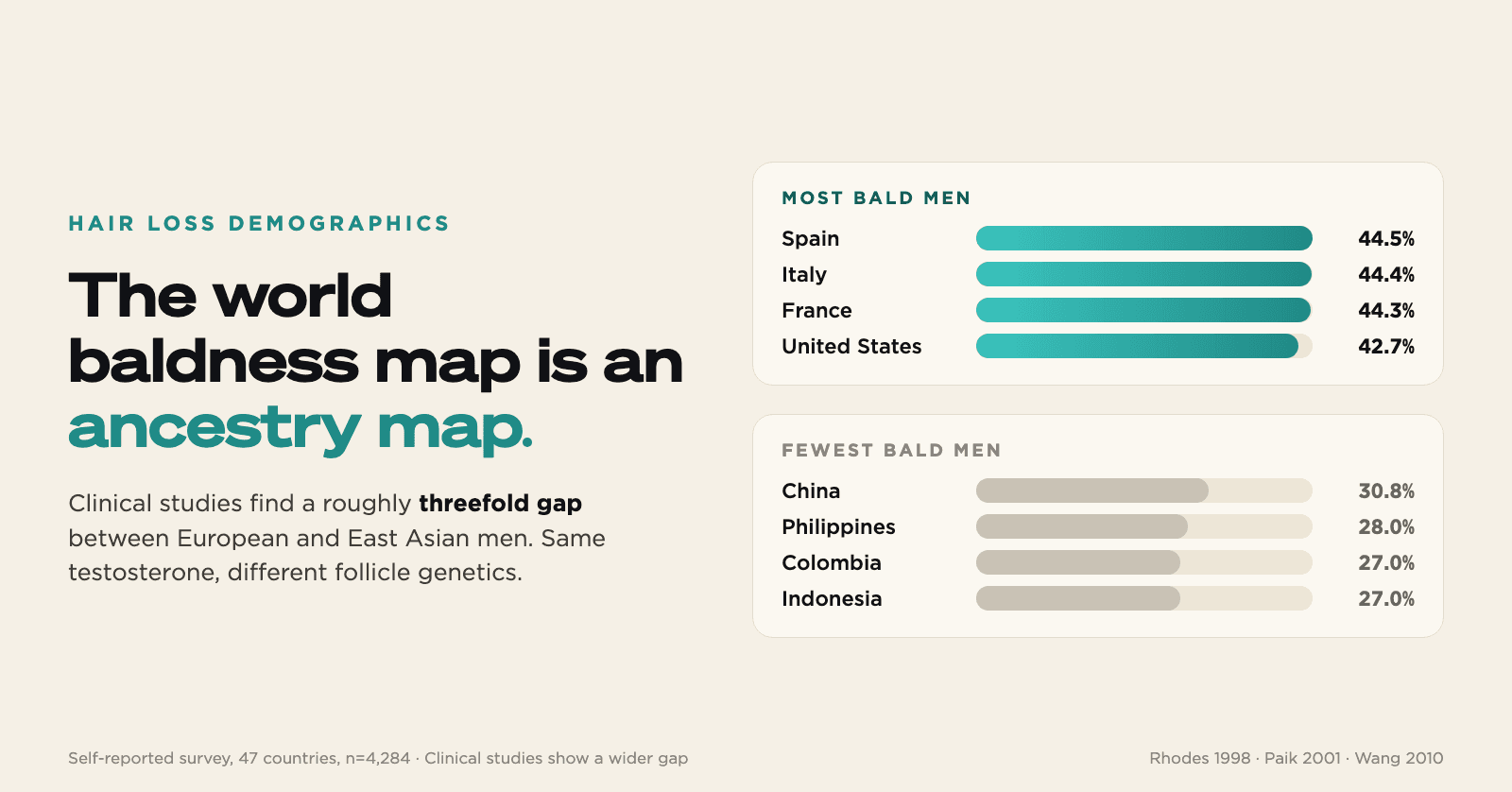
Spain tops the world baldness rankings at 44.5%, but the real story is ancestry: clinical studies find a roughly threefold gap between European and East Asian men.
Every year or two, a "world's baldest countries" map goes viral. Spain holds the current title. Czechia held it in an earlier round. The comment sections fill with theories about water, diet, stress, and sun.
Almost all of those theories are wrong, because the map is not really measuring geography at all.
The short answer: In the largest recent multi-country survey, Spain has the highest share of men reporting hair loss at 44.5%, followed by Italy at 44.4% and France at 44.3%, while Indonesia, Colombia, and the Philippines report the least at around 27 to 28%. But every top-10 country is majority European ancestry, and clinical examination studies find an even larger gap: roughly 42% of white American men aged 18 to 49 show pattern hair loss (Rhodes 1998) versus 14.1% of Korean men across all ages (Paik 2001). Pattern baldness tracks ancestry and genetics, not borders.
Spain leads the most-cited current ranking, with about 44.5% of men reporting male pattern hair loss.
The ranking comes from a hair clinic industry survey of 4,284 respondents across 47 countries, so treat the decimals as marketing precision rather than science. The top 10:
| Rank | Country | Men reporting hair loss |
|---|---|---|
| 1 | Spain | 44.5% |
| 2 | Italy | 44.4% |
| 3 | France | 44.3% |
| 4 | United States | 42.7% |
| 5 | Germany | 41.5% |
| 6 | Croatia | 41.3% |
| 7 | Canada | 40.9% |
| 8 | Czechia | 40.9% |
| 9 | Australia | 40.8% |
| 10 | Norway | 40.8% |
An earlier, widely shared ranking put Czechia first at 42.79%. That number still circulates on infographics today, usually with no traceable primary source. The two lists disagree on the order but agree on the pattern, and the pattern is the interesting part.
Indonesia reports the lowest rate of male pattern hair loss in the same survey, at about 27% of men.
The bottom 10:
| Rank | Country | Men reporting hair loss |
|---|---|---|
| 47 | Indonesia | 27.0% |
| 46 | Colombia | 27.0% |
| 45 | Philippines | 28.0% |
| 44 | Malaysia | 29.2% |
| 43 | Argentina | 29.4% |
| 42 | China | 30.8% |
| 41 | Ukraine | 30.9% |
| 40 | Thailand | 30.9% |
| 39 | Denmark | 31.6% |
| 38 | Poland | 31.8% |
Now look at both tables together. Every country in the top 10 is majority European ancestry. Nearly every country in the bottom 10 is majority East Asian, Southeast Asian, or mixed Indigenous American ancestry. The survey is not mapping countries. It is mapping gene pools that happen to live in countries.
Men of European descent have the highest measured rates of androgenetic alopecia, and the peer-reviewed clinical data shows a larger ethnic gap than any viral survey.
These numbers come from studies where dermatologists physically examined men and graded them on the Hamilton-Norwood scale, rather than asking them to self-report:
Compare like with like and the gradient is roughly threefold: 42% of white American men under 50 versus 14.1% of Korean men of all ages. The viral survey compresses that same gradient to about 1.3-fold, 42.7% versus 32.3% for the United States versus South Korea.
Which raises an obvious question.
Because self-reported surveys measure worry, while clinical studies measure scalps.
South Korea is the cleanest example. Clinically examined, Korean men have one of the lowest androgenetic alopecia rates ever recorded, 14.1% (Paik 2001). Yet in the self-report survey, South Korea sits mid-table at 32.3%, nowhere near the bottom 10. Three things produce that gap:
Method can move a national estimate by 20 points or more. A hospital-based study in Turkey found androgenetic alopecia in 67.1% of male dermatology outpatients (Salman 2017), while the multi-country survey scores Turkey at 40%. Neither is wrong. They are measuring different populations with different yardsticks.
The practical rule: hold any single-country ranking loosely, but trust the gradient. The ancestry pattern shows up in every dataset, clinical or survey, and the clinical data says the viral maps actually understate it.
Pattern baldness is overwhelmingly genetic. Twin studies estimate the heritability of male pattern baldness at roughly 80% (Nyholt 2003), making it one of the most heritable common conditions in medicine.
The molecular data agrees. A genome-wide study of over 52,000 men identified more than 250 independent genetic loci associated with male pattern baldness and could meaningfully stratify men into risk groups from DNA alone (Hagenaars 2017). The strongest single signal sits in the androgen receptor gene on the X chromosome, which is why your mother's side of the family carries real, though incomplete, information.
What the genes control is sensitivity. Men across populations run similar testosterone and DHT levels, but their follicles differ in how strongly they respond to DHT, and that response threshold is what varies by ancestry. Same hormone, different follicle programming.
That is why the country map is really an ancestry map. Populations carried their follicle genetics with them: Europe and its settler countries cluster at the top, East and Southeast Asia cluster at the bottom, and heavily mixed countries land in between.
Three caveats worth stating plainly.
First, the country ranking everyone shares is a hair clinic survey with about 4,300 respondents across 47 countries. That is roughly 90 people per country, self-reporting. It is directionally useful and nothing more.
Second, the classic low-prevalence reports for African, East Asian, and Native American men are old, and some rest on small samples. The direction has held up in every modern study that has re-examined it, but the exact percentages deserve skepticism.
Third, none of this is destiny for any individual. A Korean man can go fully bald and a Spanish man can keep every hair. Population statistics describe gene pool averages, not your follicles. If you want to know your own trajectory, your family history and a dermatoscope will tell you more than any map.
Baldness prevalence differs up to threefold across ancestries under clinical examination. The environment your scalp lives in matters far less than the DNA it inherited.
Countries do not go bald. Gene pools do.
Spain currently tops the most-cited ranking, with about 44.5% of men reporting male pattern hair loss, followed closely by Italy and France. The figure comes from a hair clinic survey of 4,284 people across 47 countries, so it is directional rather than precise. An older viral ranking put Czechia first.
Indonesia reports the lowest rate in the same multi-country survey, at about 27% of men, with Colombia, the Philippines, and Malaysia close behind. Clinical examination studies in East Asia find even lower true prevalence, such as 14.1% of Korean men in Paik 2001.
East Asian and Indigenous American men show the lowest measured rates of androgenetic alopecia. Clinical studies found 14.1% prevalence in Korean men (Paik 2001) and 21.3% in Chinese men (Wang 2010), versus roughly 42% in white American men aged 18 to 49 (Rhodes 1998). Men of African descent fall in between, below European rates.
Overwhelmingly genetics. Twin studies estimate male pattern baldness is about 80% heritable (Nyholt 2003), and a genome-wide study of 52,000 men found over 250 DNA regions linked to it (Hagenaars 2017). Population differences track ancestry, not climate, diet, or water.
Because methods differ. Self-reported online surveys inflate rates through self-selection and loose definitions, while clinical studies require a dermatologist-graded Norwood III or above. A Turkish hospital study found 67.1% prevalence (Salman 2017) where a survey scored Turkey at 40%. Age ranges also shift national estimates substantially.
On average, yes. Clinical studies in Korea and China report both lower overall prevalence and a later typical onset of androgenetic alopecia than studies of European-descent men, with Korean prevalence at 14.1% across all ages (Paik 2001). Later onset partly explains why all-age averages in East Asia look so low.
This article is for educational purposes only and is not medical advice. Androgenetic alopecia is a diagnosable medical condition; if you are experiencing hair loss, consult a licensed clinician for evaluation and treatment options.