You can now hand a lab a saliva sample and get your whole genome back for the price of a nice dinner. So it is a fair question to ask of the most-used hair drug on earth: is the answer to whether it will work for you already sitting in that file?
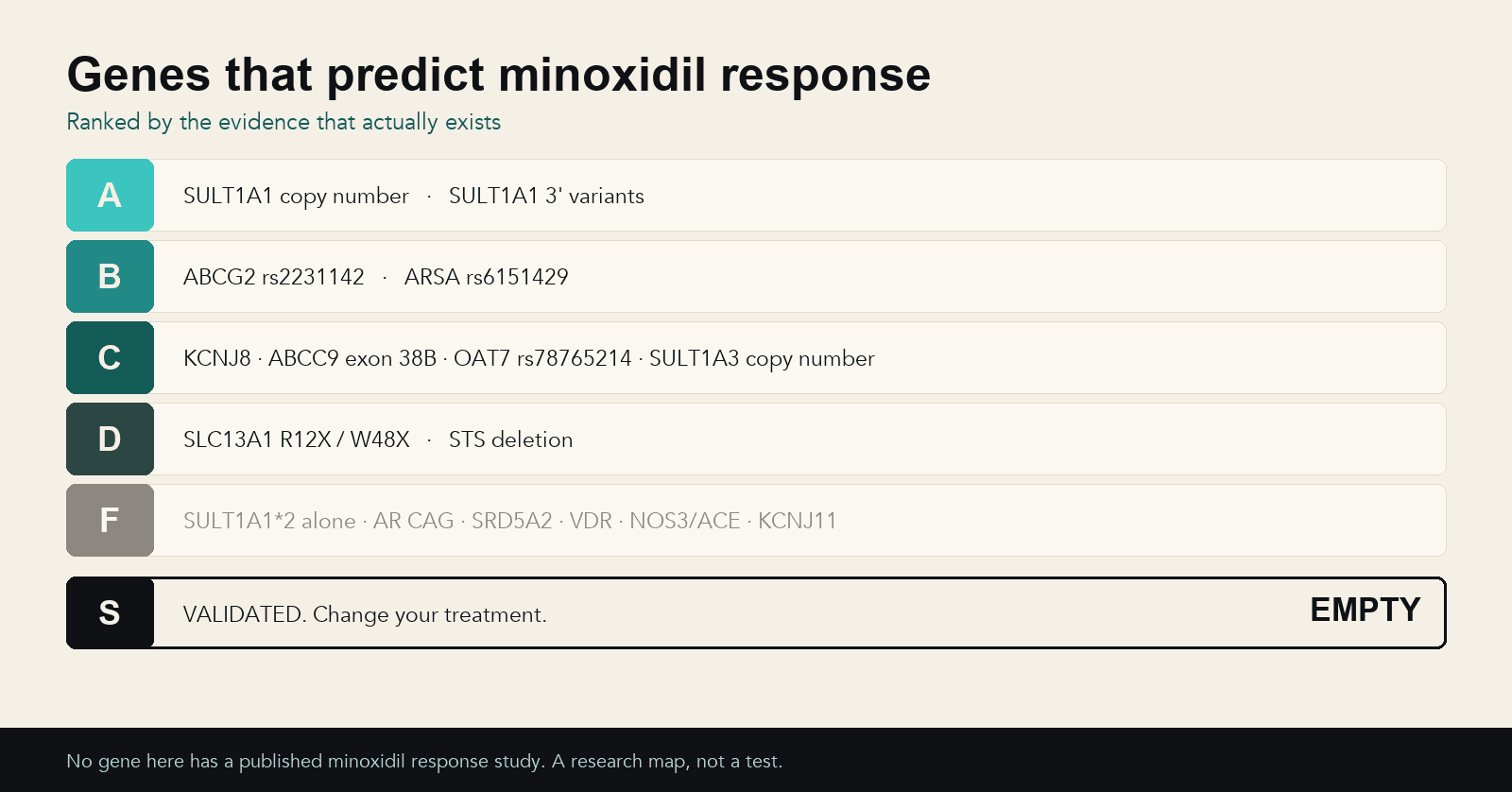
The short answer: No gene has a validated genotype-to-response study. The only paper that has ever genotyped patients and correlated it with minoxidil outcome is a single unreplicated research letter (Ramos 2021). Minoxidil appears in no clinical pharmacogenetics guideline anywhere in medicine and carries no clinical annotations in the main pharmacogenomics database. That said, if you already have whole genome data, the genes worth reading in order are SULT1A1 copy number, the SULT1A1 3' variants, then ABCG2 and ARSA. The variant nearly every consumer test reports, SULT1A1*2, is the least informative of them.
Why is there no validated minoxidil genetic test?
Because the study has never been done.
A pharmacogenetic test earns its status through a specific chain of evidence: a mechanism, then a genotype-to-outcome association, then independent replication, then ideally a trial showing that testing patients actually improves their results. Abacavir hypersensitivity screening got there with a 1,956-patient double-blind randomized trial of the screening strategy itself. Thiopurine dosing got there with an odds ratio of 35.6 across 978 patients plus independent replication.
Minoxidil has a mechanism, a widely used enzyme activity assay, and a single unreplicated genotype research letter (Ramos 2021).
There is a second, more interesting reason. Minoxidil's mechanism has almost nothing to do with what causes hair loss in the first place. Pattern baldness genetics converge on androgen signaling, Wnt pathways and connective tissue. Minoxidil works by opening a potassium channel. Those are essentially orthogonal, which is why a baldness polygenic risk score tells you nothing about whether the drug will work, and why a response panel has to be built from pharmacology rather than mined out of existing baldness studies.
How does minoxidil response actually break down?
Response is not one number. It is a chain, and it can break at any link.
The drug has to reach the follicle. It has to survive competing metabolism. It has to be converted into its active form, minoxidil sulfate, which needs both a sulfotransferase enzyme and a sulfate donor. It then has to avoid being stripped back to the inactive form, and avoid being pumped out of the cell before it does anything. Finally it has to reach its target channel, in a follicle whose growth cycle is set by a completely separate set of genes.
Almost every commercial test looks at exactly one link in that chain, and reads it with the wrong variant.
A tier: worth reading, but not the way it is sold
SULT1A1 copy number is the first thing to look at, and most people cannot see it.
Minoxidil is a prodrug that does nothing until it is converted into minoxidil sulfate, which is roughly 14 times more potent (Buhl 1990). SULT1A1 is the enzyme credited with that conversion, and people differ enormously in how much of it they run. An early study of 48 men found a roughly 15-fold spread in minoxidil sulfation between the lowest and highest (Johnson 1987).
The dominant genetic source of that spread is not a variant at all. It is gene dosage. People carry between one and about five copies of SULT1A1, and when every known source of genetic variability was weighed together across 267 liver and 23 platelet samples, copy number best explained the variation in enzyme activity (Hebbring 2007). Copy number also differs sharply by ancestry: 63% of African-American subjects in that study carried three or more copies, versus 26% of Caucasian subjects.
Whole genome sequencing can estimate copy number from read depth. A SNP genotyping array, which is what most consumer products use, generally cannot.
The SULT1A1 3' variants, rs1042157, rs6839 and rs4788068, sit at the tail end of the gene, two in the untranslated region and one just past it. In 625 people they were tested alongside the famous SULT1A1*2 variant. The star notation is how pharmacogenetics names gene variants, and *2 here means the copy carrying a single amino acid swap, Arg213His. The result was blunt: SULT1A1*2 "does not contribute to the variation in SULT1A1 enzymatic activity when the 3'-UTR SNPs are included in the statistical model" (Yu 2010). The mechanism turned out to be a microRNA, miR-631, binding the gene in a genotype-specific way.
One honest caveat from that same study: after stratifying by copy number, the 3' variants stayed significantly associated with activity in Caucasians but not in African-Americans.
B tier: the two best bets nobody has tested
Neither of these has a single minoxidil response study behind it. Both have better reasoning behind them than anything currently being sold.
ARSA, variants rs6151429 and rs2071421, is the off switch. Human hair follicle cells make sulfatases that hydrolyze minoxidil sulfate back into inactive minoxidil (Ichida 2020). If that happens at different rates in different people, a non-responder might not be short of the activating enzyme at all. They might have too much of the deactivating one, and nobody has ever measured both in the same follicle.
ARSA comes with an unusually convenient natural experiment. A meaningful share of people carry an ARSA pseudodeficiency allele that produces a large drop in enzyme activity without necessarily causing symptoms (Laugwitz 2022). That is a large, healthy, easily genotyped natural knockdown population. If the off switch matters, they should respond better to minoxidil. Testing it means genotyping an existing responder cohort, which is cheap, and it has never been done.
ABCG2, variant rs2231142, is the export pump, and it is the most under-appreciated idea in this area. Three published findings have never been connected to each other. Minoxidil sulfate is a proven substrate of the ABCG2 transporter, demonstrated in knockout mice (Enokizono 2007). Functionally active ABCG2 sits in the epithelial stem cell region of the outer root sheath, the bulge (Haslam 2015). Follicular sulfotransferase activity is reported in the outer root sheath too, though the bulge is a narrower compartment than the assay papers resolve, so the overlap is suggested rather than shown.
Put together, the cell that makes minoxidil sulfate has an active pump for it. If the drug is exported before it reaches its target, that is a second off switch working by export rather than by breakdown. rs2231142 is a common reduced-function variant, well validated for other drugs, and reduced pumping should mean more active drug staying inside the cell.
C tier: real candidates that may teach you nothing
KCNJ8 and ABCC9 encode the actual drug target, the Kir6.1 and SUR2B subunits of the potassium channel that minoxidil sulfate opens in the dermal papilla (Shorter 2008).
The causal link is proven in humans about as cleanly as biology allows. People born with an overactive version of this channel have Cantu syndrome, whose hallmark is hair growing everywhere (Harakalova 2012). Minoxidil is essentially a temporary pharmacological imitation of that condition.
So why only C tier? Because both genes are so intolerant of change that common functional variation may not exist in them to read, and because nobody has ever genotyped either one and correlated it with minoxidil response.
One technical point if you do look. ABCC9 is spliced into two forms. The hair follicle uses SUR2B, built from exon 38B. The heart uses SUR2A, from exon 38A. A panel reading the wrong exon is reading the cardiac protein.
OAT7, the gene SLC22A9, is the one readers ask about most, and it belongs here rather than higher. It is the liver's transporter for sulfate conjugates (Shin 2007), and it cannot be the follicle's uptake transporter for a simple reason: it is not in skin. Human Protein Atlas puts it at 43.3 nTPM in liver and 0.1 in skin, a more than 400-fold bias.
What keeps it on the list at all is the oral question. If oral minoxidil works partly by exporting preformed minoxidil sulfate out of the liver and into the blood, OAT7 is the named exporter that would gate that route, and that hypothesis is exactly what the oral minoxidil result covered later on this page keeps alive. The premise is unproven. The liver mostly glucuronidates minoxidil rather than sulfating it (Gottlieb 1972), and minoxidil sulfate has never been measured in human blood. No study has ever tested whether OAT7 carries it.
The reason it is worth a look anyway is that, unlike the target genes, there is something to read. SLC22A9 carries a common frameshift, rs78765214, present in roughly 15% of chromosomes and common across every major population group. That is a large natural loss-of-function population, which is what makes the question cheaply testable rather than merely interesting.
SULT1A3 copy number is probably the backup activator. It converts minoxidil in vitro (Anderson 1998) and sits at roughly 12 times the skin expression level of SULT1A1. It is also hard to read, because it sits in a segmental duplication alongside a near-identical twin, which makes short-read variant calls unreliable. Long-read sequencing can separate the two, so this is a hard problem today rather than a dead end.
D tier: rare, but actionable if positive
SLC13A1, variants R12X and W48X. Sulfation needs sulfate, and this gene governs how much is in your blood. Carriers of either nonsense variant run about 28% lower serum sulfate (Tise 2016). Fewer than 1% of people carry them, so this will almost never fire. When it does, the follow-up is a cheap blood test rather than a guess.
STS whole-gene deletion. The other candidate off switch, concentrated in the dermal papilla. When this gene fails, around 90% of the time the whole gene is simply gone from the chromosome. That is why an ordinary test misses it: a method built to read letters at fixed positions finds nothing there to read, and reports nothing. Catching it means counting copies. Worth noting that the one directly relevant piece of evidence argues against the intuitive prediction here, because follicles from people missing this enzyme still hydrolyze small sulfate esters.
F tier: which genes should you ignore?
Six: SULT1A1*2 on its own, AR CAG repeat length, SRD5A2, the vitamin D receptor, the blood flow genes NOS3 and ACE, and the potassium channel genes KCNJ11 and ABCC8. The first one is probably on your test report.
SULT1A1*2, also written rs1042028, on its own. This is the variant nearly every consumer panel reports, and it is the weakest of the three known sources of variation in the gene. It loses its association with enzyme activity once the 3' end is in the model (Yu 2010), and copy number outperforms it (Hebbring 2007). Its reputation as an activity-reducing allele was built in cancer pharmacogenetics. The one minoxidil paper to genotype SULT1A1 variants (Ramos 2021) enrolled ten women, which is too small to move it either way.
AR CAG repeat length. A meta-analysis found it null for androgenetic alopecia risk, with an odds ratio of 0.81 and a confidence interval crossing 1 (Zhuo 2012). Any panel selling CAG repeat length as a hair marker is selling an unsupported one.
SRD5A2 for drug response. The only pharmacogenetic study of dutasteride in hair loss, 42 men over six months, found its strongest signals in DHRS9 and CYP26B1, and reported no variant that survived correction for multiple testing (Rhie 2019). It was far too small to settle anything. What is clear is the absence: there is no guideline, no label section and no actionable annotation for finasteride or dutasteride response anywhere.
Vitamin D receptor. The claim that vitamin D boosts minoxidil activation traces back to a study of a different enzyme, SULT2B1b, in prostate tissue, in a paper that does not mention minoxidil (Seo 2013). That enzyme is also inactive against the chemical class minoxidil belongs to (Meloche 2001).
NOS3, ACE and the other blood flow genes. Minoxidil grows follicles in a dish with no blood supply at all, and in 76 women on topical minoxidil, scalp vascularity measured on biopsy did not predict response (Kozicka 2022). The drug classes settle it: phenytoin causes excess hair growth and is not a vasodilator at all, while ACE inhibitors and PDE5 inhibitors are potent vasodilators that cause none. Vasodilation is not the mechanism.
KCNJ11 and ABCC8. Real potassium channel genes, expressed in the follicle, with famous common variants. They form the channel pair that minoxidil does not act on (Shorter 2008).
Does any of this change for oral minoxidil?
Possibly completely, and this is the largest caveat on the page.
In 41 patients taking oral minoxidil for six months, those with low follicular sulfotransferase activity responded at 85%, versus 43% for those with high activity (Jimenez-Cauhe 2024). That is the opposite direction from the topical assumption that low activity means non-response.
The proposed explanation is that oral minoxidil may be activated in more than one location, so less follicular enzyme is needed. Whether that is right remains unresolved, and nobody has ever measured minoxidil sulfate in human blood. But it means a low-activity result on a SULT1A1 test is not a reason for someone taking the oral form to stop.
If SULT1A1 activity turns out to be the limiting step (one 2024 study found the opposite), a steadier substrate supply is the untested rationale behind the MINX smooth-release capsule.
So what order should you actually read a genome in?
If you have the data in front of you, this is the sequence that makes sense given what is known today.
Read SULT1A1 copy number first, because it is the strongest known driver of the activating enzyme and almost nobody looks at it. Then the SULT1A1 3' variants, because they outperform the variant you were probably given. Then ABCG2 rs2231142 and the ARSA pseudodeficiency alleles, which between them cover the two ways the drug can be switched off. Then ABCC9 exon 38B and KCNJ8, accepting that you may find nothing interpretable. Then the rare sulfate supply variants, which will almost certainly be negative but cost nothing to check once you already have the file.
And then stop, because the honest next step is not genetic at all. The measurements that would answer this question are an enzyme activity assay on plucked follicles and a mass spectrometry measurement of minoxidil sulfate itself. Activity beats expression, and the metabolite beats both.
S tier: validated, change your treatment
Empty.
Not one gene on this page has a replicated, adequately powered study tying your genotype to your minoxidil response. The single genotype-to-outcome paper that exists is an unreplicated research letter. That is the honest state of the field in 2026, and it is worth saying plainly, because the ranking above is a research map and not a test. The genes in A tier are the best-reasoned places to look. They are not answers.
The gene nearly every test reports sits in F tier. The two with the strongest reasoning behind them are not on any panel being sold.
Frequently asked questions
Can 23andMe or AncestryDNA tell me if minoxidil will work?
No. Two of the three most informative markers for minoxidil activation are copy number variation, which SNP genotyping arrays are generally not designed to detect, and no marker on any consumer panel has a validated association with minoxidil response. Raw data files can be searched for individual variants such as rs2231142, but the result is research-grade information, not a clinical test.
Which gene is most important for minoxidil response?
On current evidence SULT1A1, but read as gene copy number and the 3' variants rather than the SULT1A1*2 variant most tests report (Hebbring 2007, Yu 2010). No gene has a validated study tying genotype to minoxidil outcome, so most important here means best-reasoned rather than proven.
Why does my genetic test say I am a minoxidil non-responder?
Most likely it genotyped SULT1A1*2 and applied a rule borrowed from a different field. That variant stops predicting enzyme activity once the rest of the gene is accounted for, the test has not been validated against minoxidil outcomes, and for oral minoxidil the one relevant study found the association running the opposite way (Jimenez-Cauhe 2024). Discuss any result with a clinician rather than stopping treatment over it.
Is there a blood test that predicts minoxidil response better than a genetic test?
Probably. An enzyme activity assay measures what the gene actually does, and measuring minoxidil sulfate directly by mass spectrometry would measure the molecule that matters. Neither is routinely available, and no published study has correlated follicular minoxidil sulfate with clinical response.
Should I take vitamin D to improve my minoxidil response?
The evidence usually cited involves a different enzyme, SULT2B1b, in prostate tissue, in a paper that does not mention minoxidil (Seo 2013), and that enzyme is inactive against minoxidil's chemical class (Meloche 2001). Vitamin D is worth keeping at a normal level for other reasons, but it is not a minoxidil booster on this evidence.
Does a baldness polygenic risk score predict minoxidil response?
No. Baldness genetics converge on androgen signaling and Wnt pathways, while minoxidil acts on an ATP-sensitive potassium channel. The pathways are separate, and no potassium channel gene has ever reached genome-wide significance in a pattern baldness study.
References
- Buhl AE, Waldon DJ, Baker CA, Johnson GA. Minoxidil sulfate is the active metabolite that stimulates hair follicles. J Invest Dermatol. 1990. PMID: 2230218
- Johnson GA, Baker CA. Sulfation of minoxidil by human platelet sulfotransferase. Clin Chim Acta. 1987. DOI: 10.1016/0009-8981(87)90322-6
- Hebbring SJ, Adjei AA, Baer JL, et al. Human SULT1A1 gene: copy number differences and functional implications. Hum Mol Genet. 2007. DOI: 10.1093/hmg/ddl468
- Yu X, Dhakal IB, Beggs M, et al. Functional genetic variants in the 3'-untranslated region of sulfotransferase isoform 1A1 (SULT1A1) and their effect on enzymatic activity. Toxicol Sci. 2010. DOI: 10.1093/toxsci/kfq296
- Anderson RJ, Kudlacek PE, Clemens DL. Sulfation of minoxidil by multiple human cytosolic sulfotransferases. Chem Biol Interact. 1998. PMID: 9566733
- Shin HJ, Anzai N, Enomoto A, et al. Novel liver-specific organic anion transporter OAT7 that operates the exchange of sulfate conjugates for short chain fatty acid butyrate. Hepatology. 2007. PMID: 17393504
- Gottlieb TB, Thomas RC, Chidsey CA. Pharmacokinetic studies of minoxidil. Clin Pharmacol Ther. 1972. PMID: 5026381
- Ichida M, et al. Simultaneous determination of minoxidil and minoxidil sulfate by high-performance liquid chromatography with UV-detection and its applications. Medicine in Drug Discovery. 2020. DOI: 10.1016/j.medidd.2020.100050
- Laugwitz L, et al. Extremely low arylsulfatase A enzyme activity does not necessarily cause symptoms. JIMD Rep. 2022. PMID: 35822086
- Enokizono J, Kusuhara H, Sugiyama Y. Regional expression and activity of breast cancer resistance protein (Bcrp/Abcg2) in mouse intestine: overlapping distribution with sulfotransferases. Drug Metab Dispos. 2007. PMID: 17353350
- Haslam IS, El-Chami C, Faruqi H, et al. Differential expression and functionality of ATP-binding cassette transporters in the human hair follicle. Br J Dermatol. 2015. DOI: 10.1111/bjd.13549
- Shorter K, Farjo NP, Picksley SM, Randall VA. Human hair follicles contain two forms of ATP-sensitive potassium channels, only one of which is sensitive to minoxidil. FASEB J. 2008. DOI: 10.1096/fj.07-099424
- Harakalova M, van Harssel JJ, Terhal PA, et al. Dominant missense mutations in ABCC9 cause Cantu syndrome. Nat Genet. 2012. DOI: 10.1038/ng.2324
- Tise CG, Perry JA, Anforth LE, et al. From genotype to phenotype: nonsense variants in SLC13A1 are associated with decreased serum sulfate and increased serum aminotransferases. G3 (Bethesda). 2016. DOI: 10.1534/g3.116.032979
- Zhuo FL, Xu W, Wang L, et al. Androgen receptor gene polymorphisms and risk for androgenetic alopecia: a meta-analysis. Clin Exp Dermatol. 2012. PMID: 21981665
- Rhie A, Son HY, Kwak SJ, et al. Genetic variations associated with response to dutasteride in the treatment of male subjects with androgenetic alopecia. PLoS One. 2019. PMID: 31525235
- Seo YK, Mirkheshti N, Song CS, et al. SULT2B1b sulfotransferase: induction by vitamin D receptor and reduced expression in prostate cancer. Mol Endocrinol. 2013. PMID: 23579488
- Meloche CA, Falany CN. Expression and characterization of the human 3 beta-hydroxysteroid sulfotransferases (SULT2B1a and SULT2B1b). J Steroid Biochem Mol Biol. 2001. PMID: 11457664
- Kozicka K, Lukasik A, Pastuszczak M, et al. Scalp vascularization as a marker of topical minoxidil treatment efficacy in patients with androgenetic alopecia. Postepy Dermatol Alergol. 2022. PMID: 35645672
- Jimenez-Cauhe J, Vano-Galvan S, Mehta N, et al. Hair follicle sulfotransferase activity and effectiveness of oral minoxidil in androgenetic alopecia. J Cosmet Dermatol. 2024. DOI: 10.1111/jocd.16473
- Ramos PM, Gohad P, McCoy J, Wambier C, Goren A. Minoxidil sulfotransferase enzyme (SULT1A1) genetic variants predicts response to oral minoxidil treatment for female pattern hair loss. J Eur Acad Dermatol Venereol. 2021. PMID: 32567076
This article is for educational purposes only and is not medical advice, and nothing in it is a validated clinical test. No gene discussed here has a published study linking genotype to minoxidil response, and none of it should be used to start, stop or change a treatment. Topical minoxidil is FDA approved for androgenetic alopecia. Oral minoxidil is not FDA approved for hair loss and is prescribed off label, a decision to make with a licensed clinician. Genetic results should be interpreted with a qualified professional.