Product Science · Pharmacokinetics
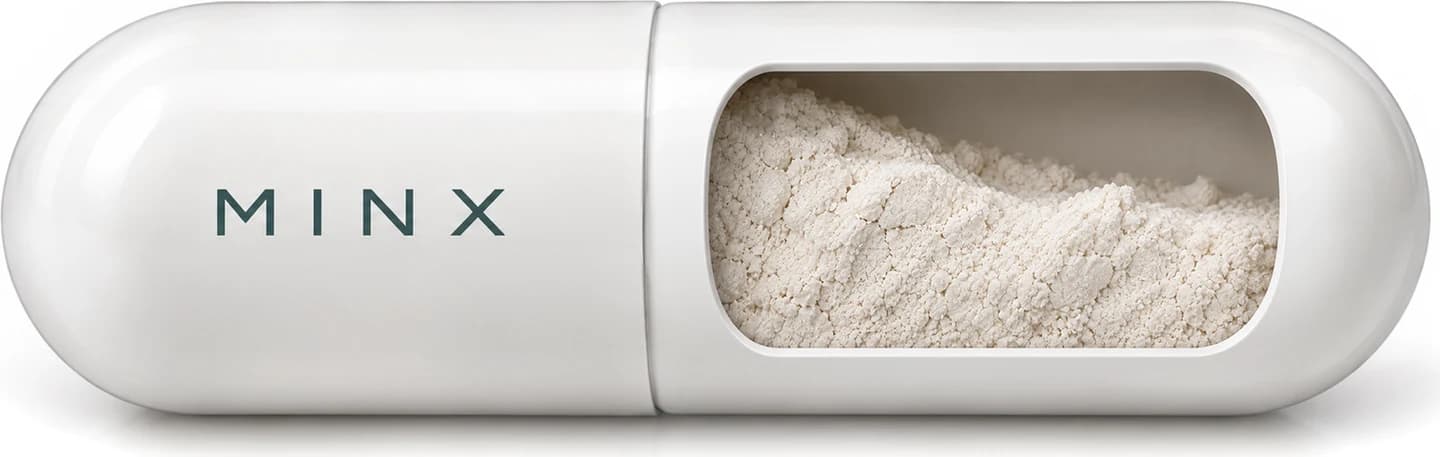
MINX — Smooth-Release Oral Minoxidil
In the fed state, MINX reshapes the oral minoxidil curve into an extended-release profile:
- Flat, not spiked: plasma minoxidil plateaus near ~6 ng/mL instead of surging, roughly one-sixth the ~37 ng/mL peak of immediate-release oral minoxidil.
- Same exposure, longer window: comparable total drug exposure (AUC), spread across the day rather than delivered in a burst.
- Later, flatter peak: a modeled Tmax around ~9–10 h, later than any previously reported for oral minoxidil.
Single-dose, exploratory pharmacokinetic analysis · n = 1 per state · Reviewed by the Anagen Research Team · Last reviewed 29 May 2026

5 mg
Single oral dose studied
~6×
Lower peak vs IR minoxidil
≈100% / ≈23%
Fed vs fasted bioavailability
3–4×
Below the cardiac-effect line
01The clinical contrast
Spike-and-crash versus sustained delivery
Plotted against a Fleishaker-calibrated immediate-release 5 mg curve, the MINX fed profile is a different pharmacological object. Immediate-release minoxidil spikes to ~37 ng/mL within about 25 minutes — into the neighborhood of the cardiac-effect concentration — then declines steeply. MINX never approaches the cardiac line and never spikes: it rises gradually to ~6 ng/mL and plateaus. The decisive contrast is the peak (≈6 vs 37 ng/mL, a ~6× reduction) and the absence of a spike, delivered at comparable total exposure.
Figure 4Plasma minoxidil — single 5 mg oral dose, IR vs MINX (fed)
- IR oral minoxidil 5 mg (Fleishaker-calibrated)
- MINX fed, measured
- MINX fed, modeled
- 21.7 ng/mL · cardiac-effect concentration
- 1.62 ng/mL · efficacy-associated
Plasma minoxidil (ng/mL)
IR peak ≈ 37 ng/mL
MINX ≈ 6 ng/mLsustained, spike-free
Cardiac-effect concentration
Time after dose (hours)
02Fed vs fasted
A food-dependent prolonged-release system
Two single-dose runs were quantified by LC-MS/MS. The profiles differ qualitatively: fasted shows a classic early peak (3.0 ng/mL at 2 h) and rapid washout, while fed shows slow, continuous accumulation that has not yet peaked by the last (8 h) sample. The fed state prolongs gastric residence and feeds continuous small-intestinal absorption; the fasted state empties the dose before the matrix can release most of its payload. The result is a ~4–5× difference in systemic exposure from an identical formulation — MINX is a food-dependent prolonged-release system. Notably, the modeled fed-state Tmax (~9–10 h) falls outside the ~0.5–6 h range previously reported for oral minoxidil — a later, flatter exposure profile than has been described for the drug to date. (Tmax here is modeled: the fed curve was still ascending at the last 8 h sample.)
Figure 1Plasma minoxidil — MINX fed vs fasted
- MINX fed, measured
- MINX fed, projected
- MINX fasted, measured
- Projection range (t½ 1.2–4.2 h)
- 1.62 ng/mL · efficacy-associated
Plasma minoxidil (ng/mL)
Fed: stillascending at 8 h
Time after dose (hours)
03Bioavailability
How much of the 5 mg is actually absorbed?
The administered dose is known (5 mg), so the pharmacokinetic question is not “what is the dose” but “what fraction is absorbed” — i.e. relative bioavailability. Benchmarking MINX exposure against Fleishaker's same-dose 5 mg immediate-release reference (AUC∞ 55.1 ng·h/mL), the fed state recovers essentially the complete 5 mg (relative bioavailability ≈100%, capped), while fasted reaches only ~23%. Recovering the known dose in the fed state validates the method.
Relative bioavailability of the 5 mg dose
| State | AUC∞ (ng·h/mL) | Rel. bioavailability vs 5 mg IR | Absorbed (≤ 5 mg) | Interpretation |
|---|---|---|---|---|
| Fasted | ~12.9 | ~23% | ~1.2 mg | Matrix swept to colon before release completes |
| Fed | ~60 (53–81) | ≈100% (capped) | ~5 mg ≈ complete | Food unlocks near-complete, sustained absorption |
Relative bioavailability is hard-capped at 100% — you cannot absorb more than the 5 mg administered. The fed point estimate lands marginally above 100%, so it is read as “near-complete,” not literal.
Reference benchmark — Fleishaker 1989 (immediate-release)
| Parameter | 2.5 mg | 5 mg | 10 mg |
|---|---|---|---|
| Cmax (ng/mL) | 16.8 | 37.2 | 74.7 |
| tmax (h) | 0.57 | 0.39 | 0.42 |
| AUC (ng·h/mL) | 25.3 | 55.1 | 112 |
| Dose-normalized AUC (per mg) | 10.1 | 11.0 | 11.2 |
| Apparent oral clearance Cl₀ (L/h) | 107 | 95.2 | 95.5 |
| Terminal t½ (h) | 1.07 | 1.27 | 1.34 |
| Vd/F (L) | 173 | 184 | 196 |
Reference benchmark — Fleishaker et al. 1989, single-dose oral minoxidil (n = 29, HPLC). The 5 mg column anchors the bioavailability analysis. Note the measured terminal t½ of ~1.1–1.3 h, materially shorter than the 4.2 h figure on the Loniten label.
04Prolonged-release reality
The tail is release-limited, not elimination-limited
For a prolonged-release product whose release is slower than the drug's intrinsic elimination, the observed terminal slope reflects the rate of release, not elimination — “flip-flop” kinetics. A Wagner–Nelson reconstruction, licensed by minoxidil's dose-linearity, recovers the cumulative amount absorbed over time. Even while fasted plasma is falling (3.0 → 1.6 → 0.78 ng/mL), cumulative absorption keeps rising; plasma drops only because elimination momentarily outpaces a still-ongoing release. So applying minoxidil's intrinsic ~1.2 h half-life to the MINX tail would be wrong — it would assume release stops at the peak.
Figure 2Wagner–Nelson cumulative absorption — fed vs fasted
- Fed, cumulative absorbed (measured window)
- Fed, projected
- Fasted, cumulative absorbed
- Nominal content: release complete (≈100%)
Cumulative absorbed (Wagner–Nelson index)
Fed: still climbing(release incomplete)
Fasted: plateausincomplete (≈7)
Time after dose (hours)
05An honest read
Time above threshold is not the win — the peak is
Both products clear the low 1.62 ng/mL efficacy-associated line for many hours, and the duration is highly sensitive to minoxidil's true half-life. At the label's 4.2 h figure, immediate-release 5 mg actually stays above the line longer than MINX, because its 37 ng/mL peak takes ~19 h to decay to 1.62. “Time above threshold” is therefore not a reliable MINX advantage. MINX's robust, defensible win is the ~6× lower peak and the spike-free shape at comparable total exposure — the safety and tolerability axis, not duration.
Figure 3Fed-state tail under three terminal-slope assumptions
- MINX fed, measured
- t½ 1.2 h: non-physical floor
- t½ 2.3 h: release-limited (realistic)
- t½ 4.2 h: fed-prolonged
- 1.62 ng/mL · efficacy-associated
Plasma minoxidil (ng/mL)
Time after dose (hours)
Back under 1.62 ng/mL at ~12 h, ~14 h and ~18 h.
06Mechanism
Why a flat curve may matter at the follicle
Minoxidil itself is inert at the follicle; the active species is minoxidil sulfate, produced by sulfotransferase (SULT1A1) in the outer root sheath (Messenger & Rundegren 2004). Sulfation is the rate-limiting step and depends on sustained substrate availability.
Immediate-release dosing saturates the enzyme briefly, then withdraws the substrate. MINX keeps minoxidil present continuously, giving the sulfotransferase system far more enzyme-hours of substrate. This is the first-principles argument that a flat, prolonged profile is not merely equivalent to immediate-release dosing, but potentially better suited to the follicular pharmacodynamic that actually drives hair growth.
Sulfation is rate-limiting
At the follicle, minoxidil is inert; the active species, minoxidil sulfate, is produced by SULT1A1 in the outer root sheath — and that sulfation step depends on sustained substrate availability.
No serum–hair correlation
Topical-minoxidil studies find no correlation between serum concentration and hair response, so no validated systemic “hair threshold” exists; follicular efficacy is local.
07The safety argument
Peak concentration, not total exposure
Oral minoxidil's cardiac liabilities — tachycardia, fluid retention, pericardial effusion — are widely hypothesized to be driven by peak concentration rather than total exposure. The minoxidil monograph anchors this: 6.86 mg, producing a mean serum concentration of 21.7 ng/mL, was the lowest dose clearly distinguishable from placebo on heart-rate data.
MINX's fed peak of ~6.5 ng/mL sits 3–4× below that line. If the peak-driven hypothesis holds, a formulation that delivers full exposure while capping Cmax at one-sixth of immediate-release should carry a materially lower cardiac burden.
The honest read
This is a mechanistic hypothesis, not a demonstrated clinical outcome.
It remains to be confirmed with cardiac monitoring in an adequately powered study.
08Limitations
What this analysis can and can't support
An honest reading of a small, exploratory dataset. These constraints bound every claim on this page.
01
Single-dose, exploratory study with very small n (n = 1 per fed/fasted state). No steady-state, no replicate variability, no formal non-compartmental software output.
02
The fed peak and the entire post-8 h tail are modeled from GI-transit physiology and release-limited (flip-flop) kinetics — not measured. Sampling did not capture the fed Cmax or the end of release.
03
Bioavailability is benchmarked against Fleishaker's cohort-mean 5 mg AUC, not this subject's own reference. AUC and clearance are not separately identifiable from oral data alone, so the ≈100% fed figure should be read as “near-complete,” not literal; a definitive absolute bioavailability needs an IV or same-subject immediate-release crossover.
04
The 1.62 ng/mL line is efficacy-associated — the mean peak after a single efficacious 0.45 mg sublingual dose (Sinclair 2022) — not a validated pharmacodynamic threshold. Topical-minoxidil studies find no correlation between serum concentration and hair response, so no validated systemic “hair threshold” exists.
05
Inter-individual variability in gastric emptying, SULT1A1 activity, and minoxidil elimination means real-world exposure and time-above-threshold will vary widely between patients.
09Questions
What people ask about MINX
Is MINX extended-release minoxidil?
MINX is designed for an extended-release profile. In Anagen's fed-state pilot, serum minoxidil was still rising at hour 8 after a 5 mg capsule taken with food. Anagen calls MINX "smooth-release," its own term for a compounded lipid-matrix capsule. The investigational extended-release tablet VDPHL01 is a different product and is not available.
Do I take MINX with food?
Yes. Take MINX once daily with food.
How does MINX compare to immediate-release 5 mg?
Same molecule, different curve. Immediate-release 5 mg (Fleishaker 1989) peaked at 37.2 ng/mL at about 25 minutes. In Anagen's fed-state pilot, a 5 mg MINX capsule was still rising at hour 8 at about 6 ng/mL.
10Sources & citations
Every figure and claim, traced to its source
Primary literature plus label and monograph sources behind the curves, thresholds, and the relative-bioavailability analysis above.
- 1Fleishaker JC, Andreadis NA, Welshman IR, Wright CE III. The pharmacokinetics of 2.5- to 10-mg oral doses of minoxidil in healthy volunteers. doi:10.1002/j.1552-4604.1989.tb03307.x
- 2Bokhari L, Jones LN, Sinclair RD. Sublingual minoxidil for the treatment of male and female pattern hair loss: a randomized, double-blind, placebo-controlled, phase 1B clinical trial. PMID 34420241doi:10.1111/jdv.17623
- 3Pharmacia & Upjohn / Pfizer. Minoxidil (LONITEN) tablets — Prescribing Information (FDA label, rev. 2015). https://www.accessdata.fda.gov/drugsatfda_docs/label/2015/018154s026lbl.pdf
- 4Health Canada Drug Product Database. Minoxidil topical Product Monograph (Rogaine 2% and equivalents), Clinical Pharmacology — Systemic Effects. https://pdf.hres.ca/dpd_pm/00040937.PDF
- 5Sobota JT. Review of cardiovascular findings in humans treated with minoxidil. PMID 2665032doi:10.1177/019262338901700115
- 6Lowenthal DT, Affrime MB. Pharmacology and pharmacokinetics of minoxidil. PMID 6156363
- 7Messenger AG, Rundegren J. Minoxidil: mechanisms of action on hair growth. PMID 14996087doi:10.1111/j.1365-2133.2004.05785.x
- 8Donovan Hair Clinic. Top 10 things you need to know about oral minoxidil. https://donovanmedical.com/hair-blog/oral-minoxidil-top-10
Go deeper
From the Anagen blog
Long-form analysis and primary-source breakdowns that go beyond the summary above.
