What Changes in a Balding Scalp, Gene by Gene
Every gene expression difference between balding and non-balding scalp that replicates across independent studies, and which famous findings do not survive scrutiny.
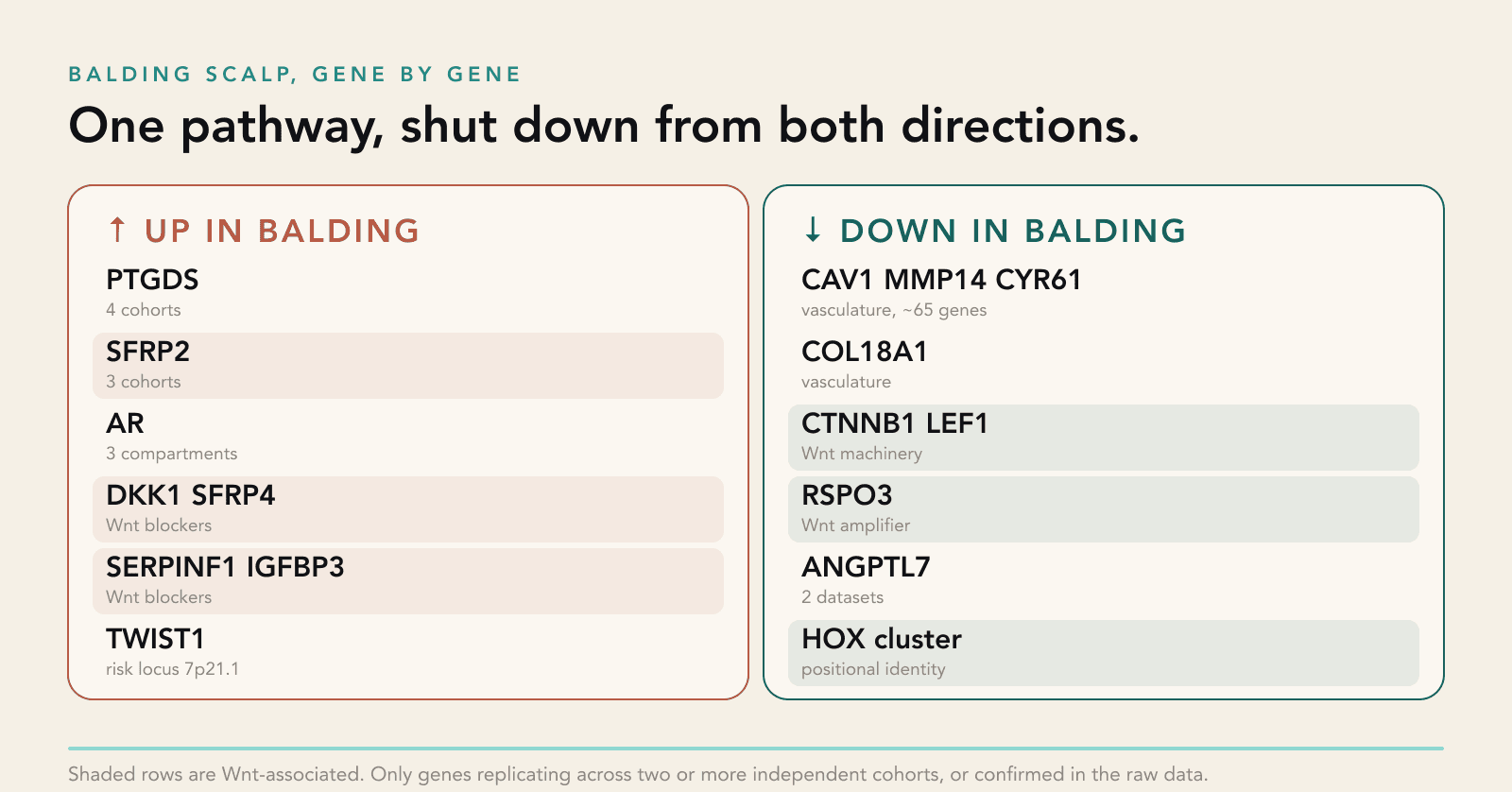
Every gene expression difference between balding and non-balding scalp that replicates across independent studies, and which famous findings do not survive scrutiny.
Ask what actually changes in a balding scalp and you will get a list of genes. Most of the entries on that list appear in exactly one study.
The short answer: Going up in balding scalp: PTGDS, SFRP2, the androgen receptor, a cluster of other Wnt blockers including DKK1, SFRP4, SERPINF1 and IGFBP3, and TWIST1. Going down: the dermal papilla's blood vessel program (CAV1, MMP14, CYR61, COL18A1 and around 60 more), the Wnt machinery itself (CTNNB1 and LEF1), ANGPTL7, RSPO3, and most of the HOX cluster. The pattern is not random. Wnt inhibitors rise while Wnt machinery and Wnt amplifiers fall, so the follicle's main growth instruction is being shut down from both directions at once. Meanwhile the stem cells themselves are still present at normal frequency. Several famous findings do not survive scrutiny, including the dramatic hair keratin collapse, which reflects there being less hair in the biopsy rather than any change in regulation.
Using a stricter rule than most summaries apply: a gene is listed only if it appears in two or more independent human cohorts, or if we confirmed it ourselves in the raw deposited data.
Independent means a genuinely separate group of people. Computational reanalyses of an existing dataset do not count as replication, because they are the same patients processed again. Neither do multiple papers built on the same pair of cell lines.
Two datasets were reanalysed directly for this article: GSE36169, which holds bald and haired scalp from five men, and GSE66663, which holds balding and non-balding dermal papilla cells. Our reconstruction of the first reproduces its published result exactly, which is the check that the method is sound.
The strongest single finding in the field on breadth of replication.
PTGDS makes prostaglandin D2. It is elevated in bald scalp across four separate cohorts: Garza and colleagues in five paired men, Michel and colleagues in fourteen patients against fourteen controls, Chew and colleagues in twenty patients with RT-qPCR validation, and Kim and colleagues in eighteen women with female pattern hair loss, where it was higher in all eighteen and confirmed at protein level.
Two caveats matter. Michel's group attributes the rise to mast cells rather than to follicles, which is a different mechanism from the usual telling. And in isolated dermal papilla cells the gene runs the other way, down roughly ten fold. So PTGDS is elevated in bald scalp tissue, and the cell producing it has never been pinned to the papilla.
A Wnt blocker, up in three cohorts: Michel (p < 0.002), Liu and colleagues in paired isolated follicles from ten men where the protein rose from 1.16 to 2.54, and Kim's eighteen women.
Up in balding papilla cells, up in whole balding scalp, and up as nuclear protein in papilla tissue. Three groups, three compartments.
This one deserves a pause, because it is not simply a downstream consequence. More receptor in the tissue means the same circulating DHT produces a larger signal locally. The follicle becomes more sensitive to a hormone level that has not itself changed.
DKK1, SFRP4, SERPINF1 and IGFBP3 all rise in balding follicles. DKK1 is the most studied of these and is directly inducible by DHT in cultured papilla cells.
Note the theme. Four separate inhibitors of the same pathway, all rising together.
A transcription factor at 7p21.1, one of the established baldness risk loci, up about 2.5 fold in balding versus non-balding dermal papilla cells.
TWIST1 is interesting beyond its expression level because of how it works. It binds histone deacetylases and represses genes by closing chromatin rather than by flipping a switch. It has also been reported to bind the androgen receptor promoter and raise AR expression, which would create a loop in which the thing androgen switches on makes the cell more androgen-sensitive. Both mechanisms come from cancer and developmental biology rather than from hair, so they are leads rather than findings.
The best-replicated finding in the entire field, and the one most people have never heard of.
Balding papilla cells lose a coordinated set of around 65 vasculature and angiogenesis genes, including CAV1, MMP14, CYR61 and COL18A1. Two were confirmed at protein level, MMP14 at p = 0.0004 and CAV1 at p = 0.0002, and a subset was reproduced in primary cells from separate patients.
More importantly it has been reproduced twice more in human tissue by other groups: once by transcriptome analysis of balding papilla, and once by single-cell sequencing of paired balding and non-balding follicles from the same men. Three groups, three technologies, same answer.
The picture is a papilla that has stopped maintaining its own blood supply.
Beta-catenin and its transcription partner. These are not upstream regulators of Wnt signalling, they are the machinery that executes it. Both fall in balding scalp.
Down in two independent datasets.
An R-spondin, meaning a Wnt amplifier rather than a Wnt ligand, down 2.8 fold in balding papilla cells in our own recomputation.
A correction belongs here, because the literature and the discussion around it usually name RSPO2. In the deposited papilla data, RSPO2 is not detectably expressed at all, sitting at the array's noise floor in both balding and non-balding cells. Neither is RSPO1. The R-spondin that actually moves is RSPO3.
Broadly suppressed in balding papilla cells. HOXB5 down 9.7 fold, HOXC6 down 7.2 fold, HOXB8 down 3.0 fold, HOXB4 down 2.5 fold, HOXC4 down 2.1 fold, HOXD3 down 1.85 fold.
HOX genes are positional identity genes. They are part of how a cell knows where in the body it sits and what it is meant to build. A papilla losing HOX expression is, in a real sense, losing part of its instruction set.
Read the two lists together and the shape is hard to miss.
Wnt inhibitors are rising: SFRP2, SFRP4, DKK1, SERPINF1, IGFBP3. Wnt machinery is falling: CTNNB1, LEF1. A Wnt amplifier is falling: RSPO3. And the positional genes sitting above all of it are falling too.
This is one pathway being shut down from several directions at once, not a single lever being pulled. That matters for anyone reading a study that reports one marker moving, because in a network like this almost any intervention will move almost any marker.
No, and this is the most encouraging fact in the whole dataset.
KRT15 positive stem cells are present at essentially the same frequency in bald and haired scalp, 4.6 percent against 5.0 percent, with p = 0.3 across eight men. What falls is everything downstream: CD200 high cells by about eight fold, CD34 positive progenitor cells by about ten fold, LGR5 messenger RNA by a factor of three. Single-cell sequencing fifteen years later found the same thing.
The follicle has not lost its reserve. It has lost the step that converts reserve into hair.
Several, and they are worth naming because they appear constantly in summaries of this literature.
The hair keratin collapse. Keratins and keratin-associated proteins fall 20 to 38 fold in bald scalp and dominate every bulk gene list. This is not regulation. A bald scalp biopsy contains fewer hairs, so it contains less hair protein. The original authors say as much. Haemoglobin. Up around 22 fold in bald scalp, reflecting blood content in the biopsy. The authors flagged it as unexplained. CD34 and CD200. Real and important, but these are cell population counts from flow cytometry, not per-cell expression changes, so they do not belong on a gene expression list. IL-6. Frequently named in hair loss writing. We searched every full text we could obtain and found no bald versus non-balding transcriptomic evidence for it at all. It does rise in papilla cells when DHT is applied in culture, which is a different and much narrower claim. WNT5A, WNT10B, DKK2, SFRP1 and BMP4. Each appears in at most one study. Not established. FGF18. Down in bulk scalp but up per follicle once the bulge is microdissected out. It lives in the bulge, and bald scalp has fewer bulges. A pure composition artifact, and the clearest demonstration of the problem.
None of this is causation. Every comparison here is balding tissue against non-balding tissue, and occipital scalp differs from frontal scalp even in men who never lose a hair. A difference can be a cause, a consequence, or a pre-existing regional trait.
The papilla cell datasets rest heavily on one immortalised cell line per group from two unmatched donors. Those lines differ from each other for reasons unrelated to hair, including an entire interferon-response program that shifts as a block. Single genes from that source should be treated as leads until confirmed in tissue, which is why the vasculature finding carries so much weight: it is the one that was confirmed in tissue, three times.
And nobody has yet measured a histone mark, a DNA methylation change, or a chromatin accessibility difference between balding and non-balding human scalp. The epigenetic layer of this story is entirely unmeasured.
Two threads run out of this list.
The first is upstream. Every arrow on this map starts with DHT acting inside the dermal papilla, and the androgen receptor being elevated there is part of why the same circulating hormone lands harder in scalp follicles than elsewhere. That is the layer current treatment acts on, and it is why we built Precision Dutasteride, formulated with the goal of acting locally in the scalp.
The second is the transcription factor sitting in the middle of the list. TWIST1 is up in balding papilla, it sits at a baldness risk locus, and it works by closing chromatin rather than by switching single genes. That makes it a candidate for the part of the problem the hormone layer does not explain. Our work on it is here: TWIST1.
Up: PTGDS, SFRP2, AR, DKK1, SFRP4, SERPINF1, IGFBP3 and TWIST1. Down: the dermal papilla's vasculature program including CAV1 and MMP14, CTNNB1, LEF1, ANGPTL7, RSPO3 and most of the HOX cluster. These are the entries supported by two or more independent human cohorts or confirmed in the raw deposited data. Longer lists exist, but most of their entries appear in only one study.
DHT is the upstream trigger, and the androgen receptor is elevated in balding tissue, so the follicle responds more strongly to it. But the changes downstream involve a whole network, and the loss of blood vessel genes and Wnt signalling in the dermal papilla is what the follicle actually experiences. Both levels are real.
Yes. KRT15 positive stem cells sit at 4.6 percent in bald scalp against 5.0 percent in haired scalp, a difference that is not statistically significant. What is depleted is the progenitor population those stem cells are supposed to become, which falls by roughly eight to ten fold.
There is no evidence for it from any comparison of balding and non-balding human scalp. IL-6 does rise in cultured dermal papilla cells exposed to DHT, which is a laboratory finding about androgen response rather than a description of balding tissue.
RSPO3. In the deposited dermal papilla data, RSPO2 is not detectably expressed in either balding or non-balding cells, sitting at the array noise floor. RSPO3 is down 2.8 fold. Discussion in this area often names RSPO2, which the data does not support.
Because there is less hair in the sample. Hair keratins are made by the hair shaft and its surrounding structures, so a biopsy from a bald area with fewer and smaller follicles contains less of that tissue and therefore fewer of those transcripts. It measures how much hair was in the tube, not a follicle changing its behaviour.
Datasets reanalysed: GSE36169 and GSE66663.
This article is educational and is not medical advice. It makes no efficacy or safety claims about any treatment. Reanalyses described here are our own and may differ in detail from the original authors' methods. Finasteride 1 mg is FDA-approved for male androgenetic alopecia. Dutasteride is not FDA-approved for hair loss in the United States and any use for that purpose is off-label and a decision to make with a clinician.