
There are two confident camps online, and both are wrong.
The first tells you hair loss is not really genetic. They are wrong: male pattern baldness is up to about 80 percent heritable (Yap 2018). The second tells you it comes from your mother's father. They are closer, but still wrong. The truth is more interesting, and for the first time we can actually put a number on it.
The short answer: Male pattern baldness comes from both parents. It is about 80 percent heritable and driven by roughly 600 genes. The single strongest gene, the androgen receptor, sits on the X chromosome and comes from your mother alone, which is the kernel of truth behind the maternal-grandfather rule. But that gene is only about 12 percent of the risk. Every other major gene is inherited from both sides. Modeling the full picture, about 56 percent of your genetic baldness risk traces to your mother and 44 percent to your father.
Do you really inherit baldness from your mother's side?
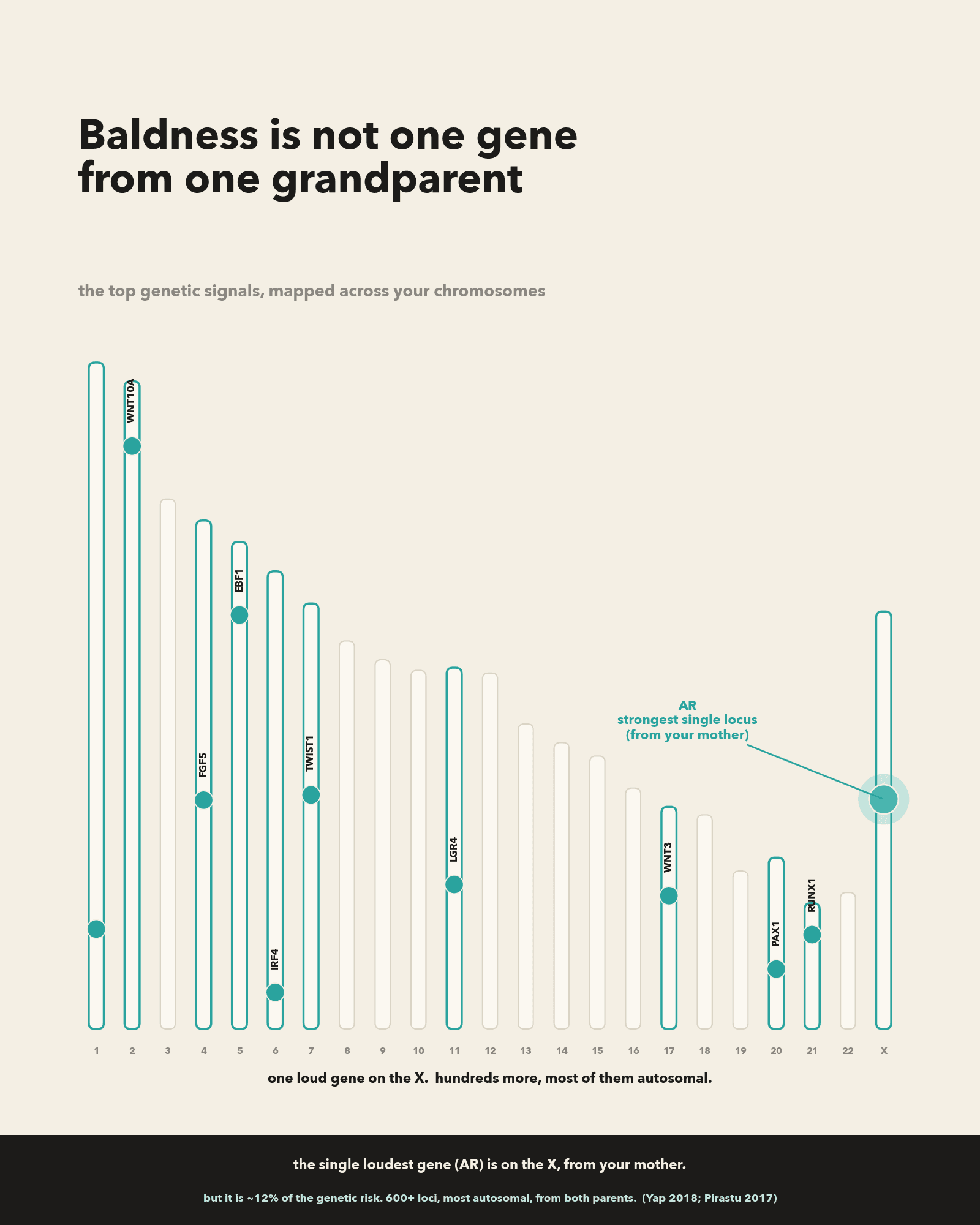
There is a real kernel of truth in the folklore. The single strongest genetic signal for baldness is the androgen receptor gene, AR, and AR sits on the X chromosome, at position Xq12. A man inherits his one X chromosome only from his mother. So the biggest individual gene really does come from your maternal line. That is why the myth survives: it is pointing at something true.
The mistake is treating that one gene as the whole story. It is not.
The ten most prominent genes, strongest first
We ranked the genome-wide-significant loci from Pirastu 2017 by their association p-value, which is the standard measure of how strong and reliable a genetic signal is. Smaller p-value means a louder, more certain signal. Here are the top ten, and which parent each comes from:
- AR (androgen receptor, Xq12): the androgen-sensitivity gene. From your mother (X chromosome).
- PAX1 (chr 20): a follicle-development transcription factor. Both parents.
- TWIST1 (chr 7): dermal-papilla and Wnt regulation. Both parents.
- IRF4 (chr 6): pigmentation and apoptosis signaling. Both parents.
- DFFA (chr 1): a DNA-fragmentation, apoptosis gene. Both parents.
- EBF1 (chr 5): timing of the growth-to-shedding switch. Both parents.
- AUTS2 (chr 7): transcriptional regulation. Both parents.
- TWIST2 (chr 2): dermal and Wnt regulation. Both parents.
- OFCC1 (chr 6): a developmental candidate gene. Both parents.
- WNT3 (chr 17): a canonical Wnt ligand, the pathway that regenerates hair. Both parents.
Read that list again. Of the ten biggest baldness genes, exactly one, AR, comes from your mother alone. The other nine are autosomal, meaning you inherit a copy from each parent. And the genes are not random: they converge on the exact machinery that builds and cycles a hair, androgen sensitivity, Wnt regeneration, and growth-phase timing.
The studies, weighted by method
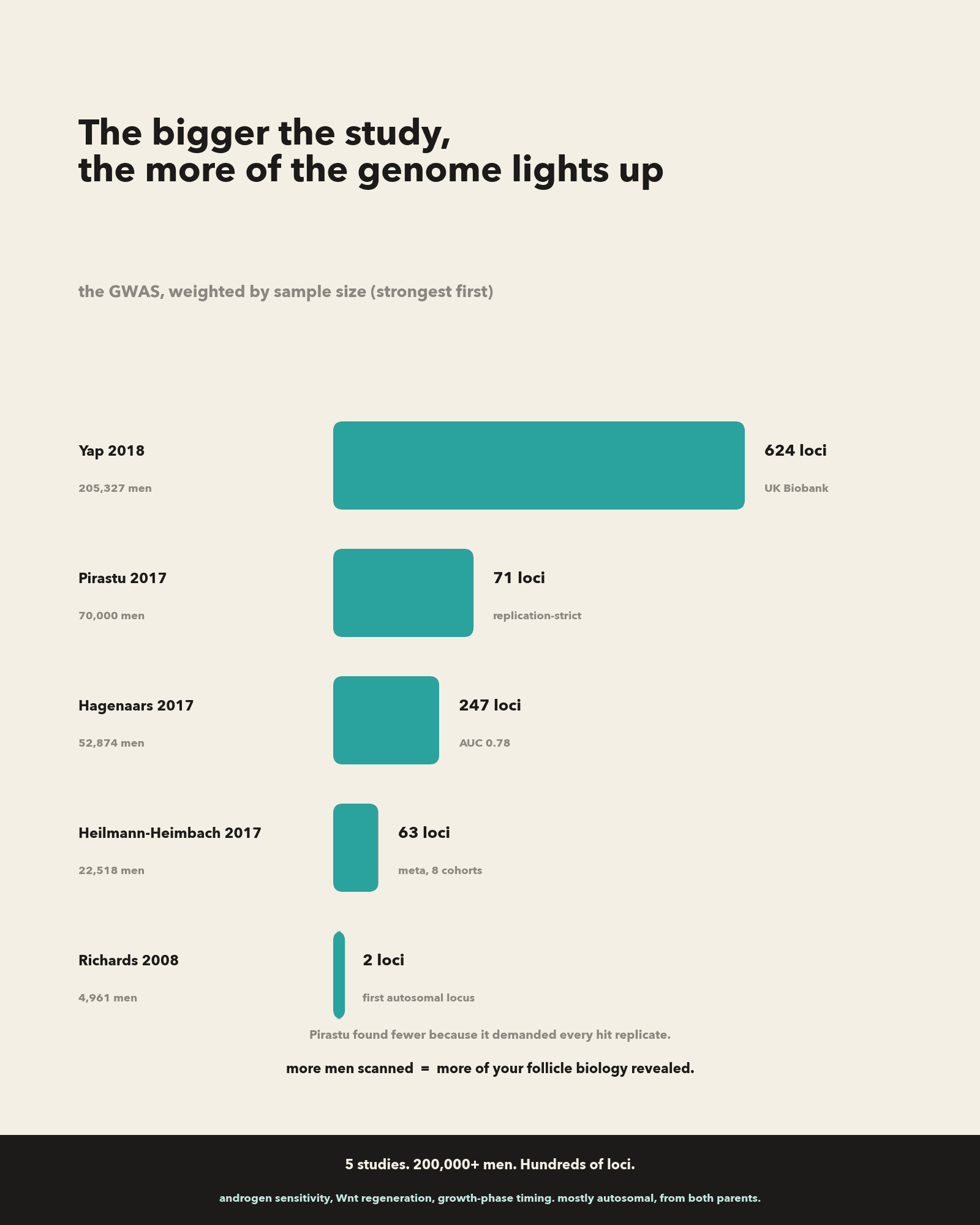
Not every study deserves equal trust. Bigger, better-designed studies find more, and find it more reliably. Ranked by sample size and rigor:
- Yap 2018 analyzed 205,327 men, the largest study to date. It detected 624 near-independent loci and put the heritability at about 0.82. The X chromosome accounts for only 11.6 percent of that genetic variance (Yap 2018).
- Pirastu 2017 studied more than 70,000 men and required every hit to replicate before counting it. Seventy-one survived. Its partition matched Yap almost exactly: 82 percent autosomal, 12 percent X (Pirastu 2017).
- Hagenaars 2017 analyzed 52,874 men, found 247 independent autosomal regions on their own, and built a polygenic score that separates men with no hair loss from men with severe hair loss at an AUC of 0.78 (Hagenaars 2017).
- Heilmann-Heimbach 2017 ran a meta-analysis of 22,518 men and found 63 loci, 57 of them autosomal. One candidate gene was SRD5A2, which encodes 5-alpha-reductase, the exact enzyme finasteride blocks (Heilmann-Heimbach 2017).
- Richards 2008, with fewer than 5,000 people, found the first baldness locus that was not on the X (20p11, between PAX1 and FOXA2) and showed that carrying the risk versions at both that autosomal locus and at AR raised the odds about sevenfold (Richards 2008).
The full list, and the maternal share
Across the largest study, the list runs to 624 loci. Only 26 of them sit on the X chromosome, the part you inherit from your mother alone. The other roughly 600 are autosomal, one copy from each parent (Yap 2018). So the maternal-only fraction of the map is small: about 4 percent of the loci, and about 12 percent of the heritable risk.
So which parent does baldness come from, your mother or your father?
Both, and it is close to even. This is the part nobody puts a number on, so we modeled it directly from the data. The logic is simple:
- The X-linked risk, about 12 percent of the heritability, comes entirely from your mother.
- The autosomal risk, about 88 percent, is inherited 50/50 by the basic rules of genetics: one copy from each parent.
Put those together:
- Mother = 12% (the X) + half of 88% = about 56%.
- Father = half of 88% = about 44%.
So of your genetic risk for going bald, roughly 56 percent traces to your mother and 44 percent to your father. It is close to a coin flip, and the entire reason your mother edges ahead is a single chromosome, the X, carrying AR. (This is a model built on the measured heritability partition plus Mendelian inheritance, not a per-person prediction.)
The honest read
- Male pattern baldness is highly heritable, up to about 80 percent.
- It is intensely polygenic. The largest study found 624 loci, spanning androgen signaling, Wnt regeneration, growth-phase timing, and follicle development.
- The single loudest gene, AR, is on the X, from your mother. That is the kernel of truth in the folklore.
- But the X explains only about 12 percent of the risk. The rest is autosomal, from both parents, and the parent split works out to roughly 56/44.
"Check your mother's father" is not wrong, exactly. It just reads one loud line of a script that runs to several hundred lines, most of them written by both sides of your family.
What we still do not know
- A large share of the heritability is still spread across many small-effect variants that have not been individually mapped.
- Almost all of these studies were done in men of European ancestry, so the scores may not transfer cleanly to other populations.
- Prediction is real but coarse: a genetic score can separate the extremes, not tell most individuals exactly what will happen. Genes set the odds, not the verdict.
Frequently asked questions
Does baldness come from your mother or your father?
Both. Male pattern baldness is about 80 percent heritable, and the risk is spread across roughly 600 genes. Only the single strongest gene, the androgen receptor on the X chromosome, comes from your mother alone. Every other major gene is autosomal and inherited from both parents. Modeling the split gives about 56 percent mother and 44 percent father.
Is it true you inherit baldness from your mother's father?
Only partly. Your mother passes you one X chromosome, which carries the androgen receptor gene, the biggest single baldness signal. But that gene explains only about 12 percent of the genetic risk, and your mother's X is itself a mix of both of her parents. So a bald maternal grandfather is a hint, not a verdict.
Can you go bald if no one on your mother's side is bald?
Yes. Because most baldness genes are autosomal and inherited from both parents, you can develop male pattern baldness even with a full-haired maternal line. In our model your father's side contributes about 44 percent of the genetic risk, so both families matter.
Which gene has the biggest effect on baldness?
The androgen receptor gene, AR, on the X chromosome at position Xq12. It sets how sensitive your follicles are to DHT and is the strongest single signal in every large study. Men inherit their X, and therefore AR, from their mother. Even so, it is only about 12 percent of the total genetic risk.
Does the maternal-grandfather rule actually predict baldness?
It is a weak rule. It points at the one X-linked gene, which is real, but ignores the hundreds of autosomal genes from both parents that make up most of the risk. A polygenic score is far better: in the largest study it separated men with no hair loss from men with severe loss at an AUC of about 0.78.
References
- Yap CX, Sidorenko J, Wu Y, et al. Dissection of genetic variation and evidence for pleiotropy in male pattern baldness. Nat Commun. 2018;9:5407. DOI: 10.1038/s41467-018-07862-y.Cited in Introduction · The studies, weighted by method · The full list, and the maternal share
- Pirastu N, Joshi PK, de Vries PS, et al. GWAS for male-pattern baldness identifies 71 susceptibility loci across 20 million SNPs. Nat Commun. 2017;8:1584. DOI: 10.1038/s41467-017-01490-8.Cited in The studies, weighted by method
- Hagenaars SP, Hill WD, Harris SE, et al. Genetic prediction of male pattern baldness. PLoS Genet. 2017;13(2):e1006594. DOI: 10.1371/journal.pgen.1006594.Cited in The studies, weighted by method
- Heilmann-Heimbach S, Herold C, Hochfeld LM, et al. Meta-analysis identifies novel risk loci and yields systematic insights into the biology of male-pattern baldness. Nat Commun. 2017;8:14694. DOI: 10.1038/ncomms14694.Cited in The studies, weighted by method
- Richards JB, Yuan X, Geller F, et al. Male-pattern baldness susceptibility locus at 20p11. Nat Genet. 2008;40(11):1282-1284. DOI: 10.1038/ng.255.Cited in The studies, weighted by method
This article is educational and is not medical advice. It describes genetic-association research, not a diagnostic or predictive test for any individual. The parent-share figures are a model built from published heritability estimates, not a personal prediction. If you are concerned about hair loss, speak with a qualified clinician.