←Back to BlogFinasteride vs. Dutasteride for Hair Loss: A Research-Backed Comparison of Effectiveness, Side Effects & Best Use Cases
Finasteride (1 mg) and dutasteride (0.5 mg) both treat hair loss by blocking DHT, but differ in strength, side effect profile, and approval status. Finasteride is a first-line option; dutasteride is stronger, works faster, but has higher side effect risk and is off-label in the U.S. Start with finasteride and switch if needed. Always consult a doctor.
By Averbs123•21 Jul 2025•Medically reviewed by Dr. Blake Bloxham, MD A 60-Second, No-Jargon Comparison
| Finasteride (1 mg) | Dutasteride (0.5 mg) |
|---|
| What it does | Switches off one DHT-making enzyme | Switches off two DHT-making enzymes |
| Who it suits | First-timers & most early-stage users | People who didn’t respond to finasteride or have fast/aggressive loss |
| When you’ll notice change | 3-6 months, keeps getting better—sometimes for years | 3-4 months, often a bit quicker/stronger |
| Sex-related side-effects | ~3–4 % of users | ~9 % of users |
| Regulatory status | FDA-approved for hair loss since 1998 | FDA-approved for prostate; used “off-label” for hair in the US (fully approved in KR/JP/TW) |
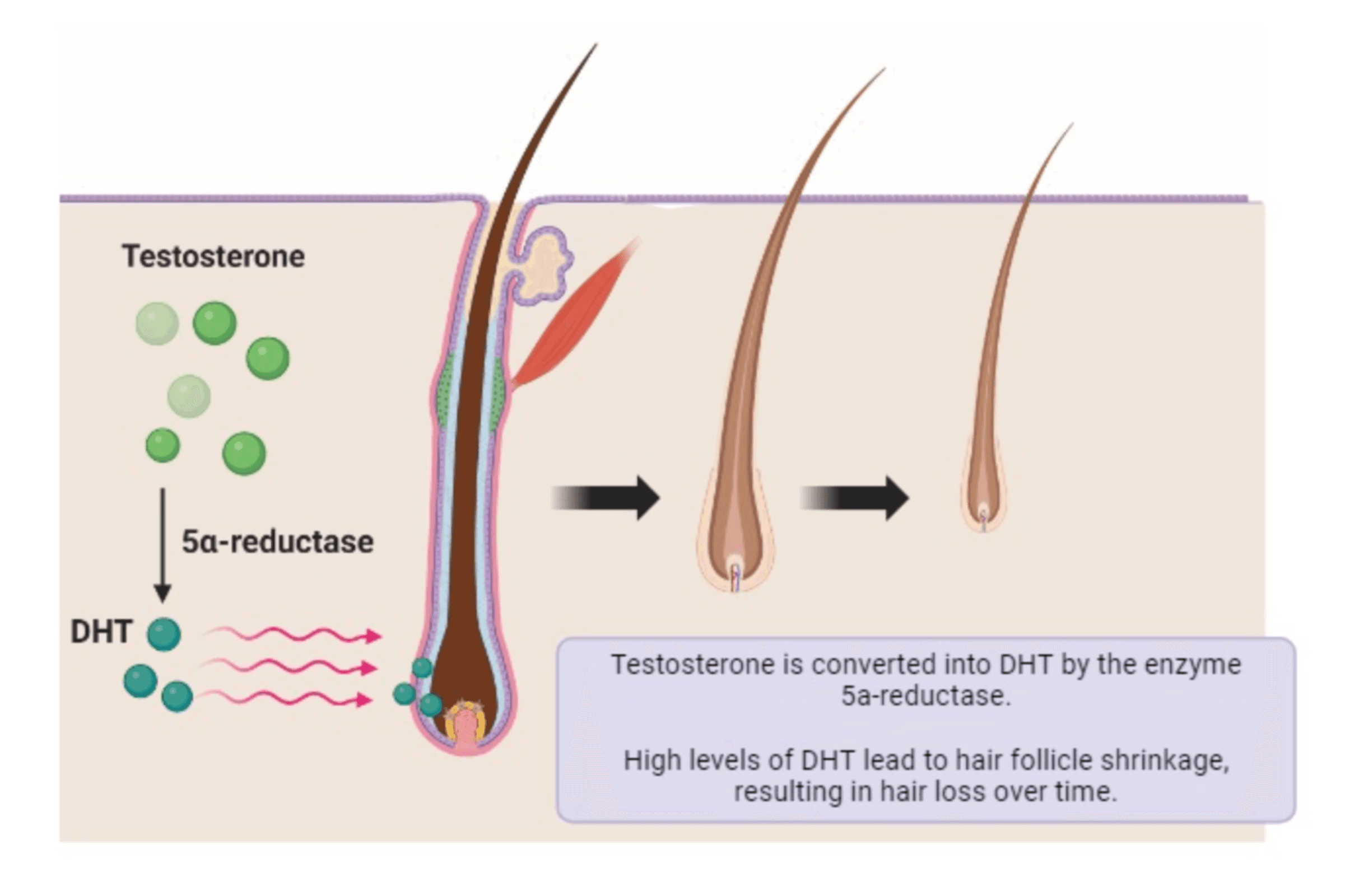
Bottom line: Try finasteride first; switch to dutasteride if the results plateau or loss is very aggressive. Either way, stay consistent and work with your doctor.
Deep Dive Comparison
| Finasteride 1 mg | Dutasteride 0.5 mg |
|---|
| 5-α-reductase isoforms blocked | Type II only | Type I and II |
| Average serum DHT reduction | ~70 % | ~98 % |
| Key clinical data | 48 % regrowth @ 1 yr, 66 % @ 2 yrs; 83 % halted loss | Superior hair-count & BASP score vs finasteride @ 24 wks |
| Long-term evidence | 91.5 % improved, 99.1 % maintained baseline after 10 yrs | Finasteride non-responders gained density +10.3 % @ 6 mo |
| Most common adverse events | Sexual: libido ↓, erectile dysfunction, ejaculation change (~3-4 %) | Sexual: libido ↓, erectile dysfunction (~9 %); reversible semen changes |
| FDA status for AGA | Approved (1998) | Off-label in US; approved in KR/JP/TW |
| Best suited for | First-line therapy, early-stage loss, risk-tolerant users | Finasteride non-responders, aggressive loss, maximal DHT suppression |
How Each Drug Works: A More Nuanced Look
- Finasteride blocks type II 5-α-reductase. Although serum DHT falls ~70 %, what matters is DHT inside the dermal papilla (DP), the engine room of the follicle, where type II dominates. In cultured DP cells, just 1 nM finasteride cuts DHT by ~86 %.¹
- Dutasteride blocks both type I and II enzymes, lowering serum DHT by ~98 %. Because type I is less abundant in the DP, the “extra” reduction is smaller at the follicle level than the serum numbers suggest, yet still clinically useful for some men.
How to Use & When to Expect Results
| Finasteride 1 mg | Dutasteride 0.5 mg |
|---|
| Dose & timing | 1 mg tablet once daily (alternate-day dosing has shown similar 12-month results in one study) | 0.5 mg capsule once daily |
| Visible change | 3-6 months; many users keep improving for several years | 3-4 months; continues improving ≤ 12 months (and sometimes longer) |
| Missed doses | One or two missed tablets are harmless because the 5-α-reductase enzyme itself turns over slowly | Half-life ≈ 5 weeks, but daily dosing is still recommended |
Efficacy: Head-to-Head Study Data
Finasteride Highlights
- Phase III trials (N = 1,879): 48 % of men showed visible regrowth at 1 year and 66 % at 2 years, vs 7 % on placebo. 83 % had no further loss at 2 years.
- 10-year Japanese follow-up (N = 532): 91.5 % improved hair density, and 99.1 % maintained or improved Norwood-Hamilton class.
Dutasteride Highlights
- Randomised dose-ranging trials: 0.5 mg dutasteride increased hair count by up to 18.67 hairs/cm² vs 14.92 hairs/cm² for 1 mg finasteride at 24 weeks.
- Finasteride non-responder switch study: Density +10.3 %, thickness +18.9 % after 6 months on dutasteride.
Side-Effects & Safety
| Finasteride 1 mg | Dutasteride 0.5 mg |
|---|
| Sexual adverse events | ~3.8 % (vs 2.1 % placebo): decreased libido, erectile dysfunction, ejaculation changes | ~9 % (vs 5.7 % placebo): similar sexual symptoms; most occur in first 3 months |
| Other adverse events ≥1 % | None significant | Breast tenderness 1.9 % vs 1 % placebo; reversible semen changes |
| Pregnancy precautions | Women who are or may become pregnant must not handle crushed tablets | Same, plus defer blood donation 6 months after last dose (longer half-life) |
Good news: Most adverse events resolve over time with continued therapy or disappear entirely after discontinuation.
Regulatory Status & Availability
- Finasteride 1 mg (Propecia® & generics): FDA-approved for male androgenetic alopecia since 1998; widely available internationally.
- Dutasteride 0.5 mg (Avodart® & generics): FDA-approved for benign prostatic hyperplasia (BPH); prescribed off-label for hair loss in the U.S., but officially approved for androgenetic alopecia in South Korea, Japan, and Taiwan.
Which Pill Should You Choose?
| Scenario | Recommended Approach |
|---|
| First-time oral therapy, early or moderate hair loss, lower risk tolerance | Start with finasteride 1 mg |
| Minimal response after 12 months of finasteride | Switch to dutasteride 0.5 mg |
| Rapid, aggressive loss at temples & vertex | Consider trying dutasteride first with physician oversight |
| Actively trying to conceive in next 6 months | Postpone systemic therapy; explore topical nanocarriers, microneedling, or PRP |
8. Maximizing Results: Practical Tips
- Be consistent: steady suppression > perfect daily streaks.
- Stack proven options: add 5 % topical minoxidil, T3, or (soon) HairDAO’s liposomal-dutasteride for extra growth.
- Track progress: photos every 3 months or schedule a trichoscan by emailing support@anagen.xyz.
- Report side-effects early: simple tweaks (dose-splitting, alternate-day dosing) often help.
Note on lifestyle: General health is great, but male-pattern hair loss is almost always genetic/hormonal; diet, gyms, or meditation alone rarely move the needle without medication.
Maximizing Results: Practical Tips
- Stay consistent: daily dosing keeps DHT suppressed.
- Combine proven treatments: add 5 % minoxidil foam or soon HairDAO’s proprietary liposomal dutasteride topical for synergy.
- Document your journey: take well-lit photos every 3 months; subtle progress adds up. Alternatively email support@anagen.xyz to schedule a trichoscan appointment.
- Report adverse events promptly: dose-splitting or schedule tweaks often fix issues.
- Lifestyle matters: optimize sleep, protein intake, vitamin D, iron, and manage stress for healthier hair.
Join the Anagen & HairDAO Community
- Share before-and-after photos on Discord, Instagram, X, & TikTok with #AnagenHairGrowth
- Discuss protocols and new research in our Discord with our community.
- Book a complimentary 15-minute telehealth call with me (Andrew Verbinnen, Anagen co-founder) to customize your plan.
Let’s get HAIRy together!
References
- McClellan KJ, Markham A. Finasteride: A Review of Its Use in Male Pattern Hair Loss. Drugs. 1999;57(1):111-126.
- Yanagisawa Y, et al. Long-term Efficacy and Safety of Finasteride in Japanese Men with Androgenetic Alopecia: 10-Year Observational Study. Journal of Dermatology. 2023;50(3):256-264.
- Choi JH, et al. Comparative Efficacy of Oral Dutasteride Versus Finasteride in Male Androgenetic Alopecia: Multicentre Real-World Study. Dermatologic Therapy. 2022;35(10):e15441.
- Gubelin Harcha W, et al. Randomized, Placebo-Controlled, Dose-Ranging Study of Dutasteride in Male Pattern Hair Loss. Journal of the American Academy of Dermatology. 2016;75(5):1014-1021.
- Olsen EA, et al.; Dutasteride Alopecia Research Team. The importance of dual 5α-reductase inhibition in the treatment of male pattern hair loss: results of a randomized placebo-controlled study of dutasteride versus finasteride. Journal of the American Academy of Dermatology. 2006 Dec;55(6):1014-1023. doi: 10.1016/j.jaad.2006.05.007. PMID: 17110217.
- Jung JY, et al. Efficacy of Dutasteride in Men with Androgenetic Alopecia Unresponsive to Finasteride. International Journal of Dermatology. 2014;53(11):e542-e549.
- Eicheler W, Huth A, Happle R & Hoffmann R (1996). RNA-levels of 5α-reductase and androgen receptor in human skin, hair follicles and follicle-derived cells. In: Van Neste DJJ & Randall VA (Editors), Hair Research for the Next Millenium. Elsevier Science, Amsterdam, 327-331.
Disclaimer
This content is for informational purposes only and is not medical advice. Always consult a licensed healthcare professional before starting, stopping, or changing any medication.