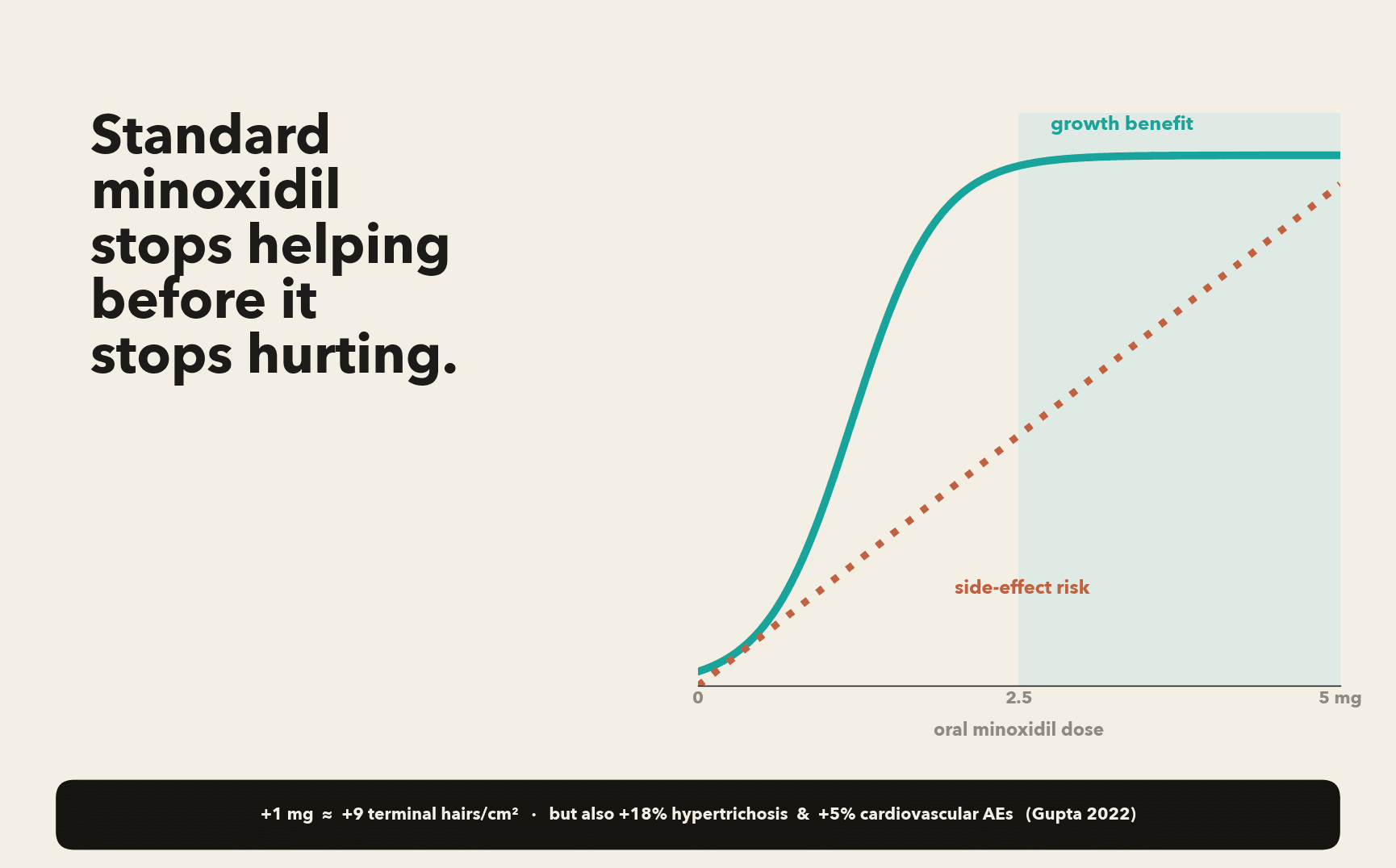
Oral minoxidil's growth and its side effects are bought with the same currency: dose.
For most of the dosing range that is just true. You take more drug, you grow more hair, you accept more side effects in exchange. That is the classical dose-response trade-off, and it is how the field has thought about minoxidil for decades.
But there is a part of the curve nobody told you about.
Near the top of the dosing range, the growth curve starts to bend. The side-effect curve does not. You stop buying much more hair, but you keep paying the side effects.
That divergence is the most interesting finding in modern minoxidil pharmacology. It is also the opening for a different question: what if the lever is not the dose, but the shape of the plasma curve?
We will walk through the data in three segments. The low end, where growth and side effects move together per milligram. The middle, where the growth curve bends. The high end, where the side-effect curve keeps climbing. Then the mechanism most likely behind the bend, and what it means for how you should think about your own dose.
At the low end (0.25 to 2.5 mg), growth and side effects move together per milligram
The cleanest summary of the low-dose oral minoxidil literature is a 2022 meta-regression by Gupta and colleagues across the published LDOM trials in androgenetic alopecia (Gupta et al., 2022, Skin Appendage Disord). The authors pooled the LDOM trials and fit a slope across them, asking: what does each additional milligram of daily dose actually buy you?
On the growth side, all measured at 6 months:
- Total hair density rises about 47 hairs per square centimeter per +1 mg per day (p=0.007).
- Terminal hair density (the visible, pigmented kind that builds coverage) rises about 9 hairs per square centimeter per +1 mg per day (p=0.001).
- Hair fiber diameter rises about 1.4 micrometers per +1 mg per day (p=0.01).
These are real, statistically supported effects. Every extra milligram does something for the hair.
On the side-effect side, same dose range, same per-milligram slope, same paper:
- Hypertrichosis risk rises about 18 percentage points per +1 mg per day (p=0.006).
- Cardiovascular adverse event risk rises about 5 percentage points per +1 mg per day (p=0.004).
The honest read of Gupta 2022 is that at the low end of the range, both curves are climbing at the same pace per milligram. The two axes are coupled. Growth and side effects are bought with the same currency: dose.
One important caveat on what this paper does and does not prove. Gupta 2022 is an across-study (ecological) meta-regression. It estimates an average slope across the published LDOM literature. It is associative, not within-patient causal. The slopes are real and statistically supported, but the cleanest interpretation is "across the literature, higher doses are associated with more growth AND more side effects per milligram," not "in any given patient, adding 1 mg will produce exactly this delta on either axis."
With that caveat in hand: at the low end, the trade is real, the trade is symmetric, and you are spending side effects to buy hair.
At the middle (2.5 to 5 mg), the growth curve bends. The side-effect curve does not.
In 2025, Fonseca and colleagues at a single center in Brazil published the first head-to-head double-blind randomized controlled trial directly comparing 2.5 mg and 5 mg oral minoxidil in male androgenetic alopecia (Fonseca et al., 2025, J Am Acad Dermatol).
The setup. One hundred men with Norwood-Hamilton stage 3V to 5V androgenetic alopecia, randomized 1:1 to either 2.5 mg or 5 mg oral minoxidil daily for 24 weeks. The primary endpoint was the change in nonvellus hair density at the vertex, measured by hair-to-hair matched trichoscopy.
The result on the growth axis. Nonvellus hair density gain was about 10 hairs per square centimeter in BOTH arms. The between-arm difference was 0.9 hairs per square centimeter (95% confidence interval -2.6 to 4.5; p=0.40). Total hair density change was also not significantly different between arms (p=0.078).
Blinded dermatologists assessed standardized photographs. They rated 64% of patients in the 2.5 mg arm as improved, and 62% in the 5 mg arm (p=0.39). A statistical tie.
So on the growth axis, between 2.5 mg and 5 mg, doubling the dose did not move the needle.
On the side-effect axis, it did. In the SAME trial, pedal edema and dizziness were significantly more common in the 5 mg arm (p=0.024). The Gupta 2022 per-milligram side-effect slope held. The Fonseca 2025 plateau on the growth axis did not extend to the side-effect axis.
Same hair. More side effects.
That is the inflection point. From 0.25 mg up through about 2.5 mg, the Gupta slopes say you are paying side effects to get hair. From 2.5 mg to 5 mg, you are paying the side effects with no extra hair to show for it.
A few honest catches. This is one trial, n=100, 24 weeks, single center. It needs replication. The Fonseca authors hedge the plateau as "individual responsiveness, potentially influenced by genetic or epigenetic mechanisms," not a proven enzymatic ceiling. And patient self-reported improvement was actually higher in the 5 mg arm (92% vs 84%, p=0.009). Fonseca's group attributes this to a faster hair growth rate at higher doses (Barbosa et al., 2024) even when density at endpoint matches.
But the primary endpoint, the objectively measured nonvellus density change, is a tie. And the side-effect divergence is real.
At the high end (5 mg and up), side effects keep climbing without proven extra growth
What about past 5 mg?
The literature here is thinner. Sanabria and colleagues published a small prospective dose-escalation study in 2024: 11 men with male androgenetic alopecia were escalated from 5 mg to 7.5 mg oral minoxidil daily, with 24-hour Holter monitoring and ambulatory blood pressure monitoring before and after (Sanabria et al., 2024, An Bras Dermatol).
The headline finding: heart rate rose at 7.5 mg compared to 5 mg. Maximum 24-hour heart rate went from 124.5 bpm on 5 mg to 131.9 bpm on 7.5 mg. The change did not reach statistical significance in this small sample (p=0.142 for the 5-to-7.5 step), but the signal is in the wrong direction. Blood pressure was unchanged, which is reassuring on its own axis.
The pharmacovigilance literature on higher doses tells a similar story. Gupta and colleagues identified a disproportionate reporting signal for pericardial effusion across the LDOM range (Gupta et al., 2025, J Cosmet Dermatol). At doses 1.25 mg or below the reporting odds ratio was 16.41; at 2.5 mg or below it was 13.30. FAERS is not the same as a prospective trial. It captures spontaneous reports and is subject to reporting biases. But it is the cleanest signal we have that exposure-driven side effects do not zero out at any dose, and the per-milligram exposure relationship from Gupta 2022 says they keep climbing.
The single most reassuring dataset is the largest one. Vañó-Galván and colleagues followed 1,404 patients on LDOM at doses typically between 1 and 5 mg daily (Vañó-Galván et al., 2021, J Am Acad Dermatol). Hypertrichosis in 15.1%, driving discontinuation in 0.5%. Systemic adverse effects in 5.5% overall (lightheadedness 1.7%, fluid retention 1.3%, tachycardia 0.9%). Zero life-threatening events. Zero pericardial effusion in that cohort.
Reassuring at hair-loss doses. But the per-milligram slope from Gupta 2022 says that as you push the dose up, those numbers go up too.
The mechanism: minoxidil is a prodrug, and its activating enzyme has a top speed
The leading mechanistic hypothesis for why the growth curve bends is enzyme saturation in the follicle.
Minoxidil itself does nothing. It is a prodrug. An enzyme in the hair follicle called SULT1A1 has to convert it to its active form, minoxidil sulfate, before it can act on a hair (Buhl et al., 1990, J Invest Dermatol). The original Buhl paper showed in vitro that minoxidil sulfate, not the parent compound, is what stimulates hair follicles.
SULT1A1 activity varies meaningfully across patients. Roberts and colleagues, in a cohort of women with female-pattern hair loss, showed that the sulfotransferase activity in plucked hair follicles predicted response to topical minoxidil with 93% sensitivity and 83% specificity (Roberts et al., 2014, J Am Acad Dermatol). The enzyme is the bottleneck. If your follicular SULT1A1 is high, you convert efficiently and you respond. If it is low, you do not.
And the enzyme has a ceiling. The amount of minoxidil sulfate it can produce per unit time is rate-limited. Once you saturate it, dumping more substrate at it does not produce more product. The extra unreacted minoxidil stays as parent compound in the bloodstream (Fleishaker et al., 1989), where it drives the peak-driven side effects.
That is the most plausible mechanism behind the Fonseca 2025 plateau. At about 2.5 mg, the SULT1A1 enzyme in a typical responder's follicle is already operating near its top speed. Pushing the daily dose to 5 mg does not make more sulfate at the follicle; it just makes more unreacted minoxidil in the bloodstream. More substrate, same product, more side effects.
To be clear, this is the inferred mechanism. The dose-finding pharmacokinetic-pharmacodynamic study that would directly measure the human follicular SULT1A1 Km has not been published. The Fonseca authors themselves hedge the plateau as "individual responsiveness, potentially influenced by genetic or epigenetic mechanisms." But the saturation hypothesis is consistent with everything we know about prodrug pharmacology, with the Buhl 1990 in vitro work, and with the Roberts 2014 clinical-response data, and it explains both the growth plateau and the side-effect rise in a single mechanism.
The opening in the trade: same dose, different curve
The mechanism leaves a door open.
If the bottleneck is a fast spike that saturates SULT1A1 in the first hour and then leaves the enzyme starved by hour six, the natural counterfactual is: what would happen if you fed it the same daily dose more slowly?
You would never push the substrate past the enzyme's top speed in any single hour. You would never jolt the bloodstream into the peak concentration that drives the acute side effects. More of the drug would have a sustained chance to convert at the follicle. Less of it would spill, unreacted, into your heart.
Same total daily dose. Smoother plasma curve. A different shape on both axes.
Dose is only half the curve; peak height matters too, which is the variable MINX is designed to change at a fixed daily dose.
This is the open question MINX is built to test. MINX is a 503A compounded smooth-release oral minoxidil formulation built around the saturation hypothesis. In our two-subject pharmacokinetic pilot the modeled fed peak was about 6.5 ng/mL at 9 to 10 hours, roughly six times lower than the reference immediate-release peak at the same daily dose, with comparable area under the curve (Bakst et al., 2026). The plasma profile sits well below the immediate-release peak across the dosing day.
Whether a smoother plasma curve translates into a better growth-to-side-effect ratio in patients is an empirical question we have not yet answered. The pilot characterizes the formulation's pharmacokinetics; it does not prove a clinical advantage. The trial that would convert the saturation hypothesis from a plausible mechanism into a validated clinical lever has not been run. That is the next chapter.
What this means for how you should think about dose
Three takeaways from this body of evidence.
First, "more is better" does not extrapolate. If you are responding to LDOM and your side effects are tolerable, the case for chasing higher doses past about 2.5 mg is much weaker than the older AGA-dose-finding literature would suggest. Fonseca 2025 is one trial, but it is the right trial design (double-blind, head-to-head, primary endpoint pre-registered, n=100, 24 weeks), and the answer it gave was a statistical tie on the growth axis and a divergence on the side-effect axis.
Second, if you are NOT responding to LDOM, dose escalation alone may not be the answer. The Fonseca data suggests the average patient does not get additional density from going to 5 mg. There may be patients with very high follicular SULT1A1 activity who do see continued gains with dose. For most people, the enzyme is the rate limit, and a different mechanism (different drug, different combination, different delivery) is more likely to move the needle than a higher daily dose of the same compound.
Third, if you are getting side effects, lowering the dose is the most direct lever, and that is a conversation for you and your clinician. Acute effects (heart rate, palpitations, dizziness) appear to be peak-driven. Chronic exposure-driven effects (fluid retention, hypertrichosis, the rare pericardial signal) are driven by total daily exposure. Both scale with dose. Cutting the dose lowers both kinds, with the trade-off described above on the growth side.
Oral minoxidil for hair loss is off-label, so none of this is a dosing instruction. The right dose is the one you and your clinician reach by weighing exactly this trade.
The actionable read
The dose-response curve for oral minoxidil is not a straight line. It bends.
At the low end, growth and side effects are bought with the same currency, dose for dose. In the middle, the growth curve bends while the side-effect curve does not. At the high end, the side-effect curve keeps climbing without proven extra growth on the average patient.
That is the trade. It is also the opening. The dose is one lever. The shape of the plasma curve is another. The first is conventional dose titration, and the literature on it is what you read above. The second is the open question MINX is built to test.
The MINX line
Smooth-release oral minoxidil, two tiers
Where this dose-curve thinking shows up in product. Both are 503A compounded, prescribed by a licensed clinician after consultation, off-label for androgenetic alopecia, and built around the same smooth-release thesis above.
Disclaimer
This blog is for educational purposes only and is not medical advice. Oral minoxidil is not FDA approved for androgenetic alopecia and is used off-label under clinician supervision. Topical minoxidil is FDA approved. MINX is a 503A compounded preparation, prescribed by a licensed clinician after consultation, not an FDA-approved drug. The pharmacokinetic data we cite is modeled where labeled "modeled" and measured where labeled "measured"; the two-subject MINX pilot is exploratory and is not a clinical efficacy trial. Talk to your dermatologist before changing any treatment.
References
-
Gupta AK, Hall DC, Talukder M, Bamimore MA. There is a positive dose-dependent association between low-dose oral minoxidil and its efficacy for androgenetic alopecia: findings from a systematic review with meta-regression analyses. Skin Appendage Disord. 2022;8(5):355-361. DOI: 10.1159/000525137.
-
Fonseca LPC, Miot HA, Prescendo Chaves CR, Müller Ramos P. Oral minoxidil 2.5 mg versus 5 mg for male androgenetic alopecia: a double-blind randomized clinical trial. J Am Acad Dermatol. 2025. DOI: 10.1016/j.jaad.2025.09.031. PMID: 40962189.
-
Vañó-Galván S, Pirmez R, Hermosa-Gelbard A, et al. Safety of low-dose oral minoxidil for hair loss: A multicenter study of 1404 patients. J Am Acad Dermatol. 2021;84(6):1644-1651. PMID: 33639244.
-
Sanabria BD, Pirmez R, Donati A, Miot HA. Oral minoxidil 7.5 mg for hair loss increases heart rate with no change in blood pressure in 24-h Holter and 24-h ABPM. An Bras Dermatol. 2024. DOI: 10.1016/j.abd.2023.08.016.
-
Sanabria BD, Pirmez R, Donati A, et al. Prospective 24-h Holter and ABPM in 34 men using 5 mg/day oral minoxidil for androgenetic alopecia. J Am Acad Dermatol. 2023;88(2):436-437. DOI: 10.1016/j.jaad.2022.05.026.
-
Gupta AK, Wang T, Bamimore MA, Talukder M. Low-dose oral minoxidil and adverse events: FAERS analysis with focus on pericardial effusions. J Cosmet Dermatol. 2025;24:e16574. DOI: 10.1111/jocd.16574.
-
Buhl AE, Waldon DJ, Baker CA, Johnson GA. Minoxidil sulfate is the active metabolite that stimulates hair follicles. J Invest Dermatol. 1990;95(5):553-557. DOI: 10.1111/1523-1747.ep12504905. PMID: 2230218.
-
Roberts J, Desai N, McCoy J, Goren A. Sulfotransferase activity in plucked hair follicles predicts response to topical minoxidil in the treatment of female androgenetic alopecia. J Am Acad Dermatol. 2014;70(5):e90-e91. DOI: 10.1016/j.jaad.2014.04.011.
-
Fleishaker JC, Andreadis NA, Welshman IR, Wright CE. The pharmacokinetics of 2.5- to 10-mg oral doses of minoxidil in healthy volunteers. J Clin Pharmacol. 1989;29(2):162-167. PMID: 2715373.
-
Bakst A, Verbinnen A, Graumenz M, et al. Food-dependent prolonged-release oral minoxidil suppresses peak systemic exposure: dissolution and pilot pharmacokinetic characterization. Anagen General Intelligence. 2026.