Quick Timelines by Treatment
Discover how long hair loss treatments take to work. Compare minoxidil, finasteride, dutasteride, spironolactone, transplants, and more with our quick treatment timelines chart.
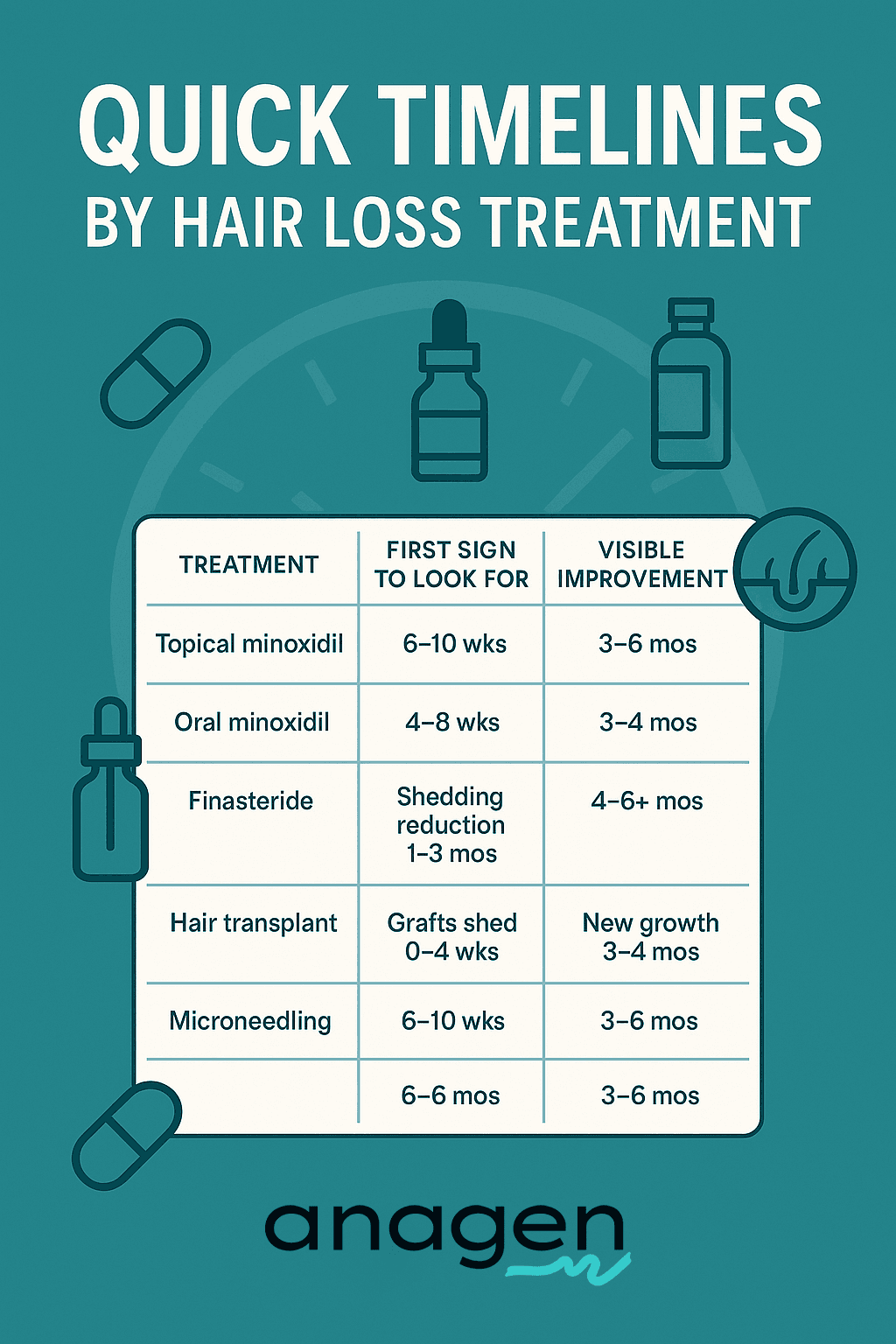
Discover how long hair loss treatments take to work. Compare minoxidil, finasteride, dutasteride, spironolactone, transplants, and more with our quick treatment timelines chart.
| Treatment | First sign to look for | Visible improvement | Peak / plateau | Notes |
|---|---|---|---|---|
| Topical minoxidil | Less shedding by 6–10 wks | 3–6 mos | 6–12 mos | Upfront shed is common; daily adherence matters. |
| Oral minoxidil (off-label) | 4–8 wks | 3–4 mos | 6–12 mos | Often faster than topical; higher chance of systemic side effects. |
| Finasteride (oral) | Shedding reduction 1–3 mos | 4–6+ mos | ~12 mos | Most proven DHT-lowering option (men). |
| Topical finasteride | 2–3 mos | 4–6+ mos | ~12 mos | Lower systemic exposure; consistent application required. |
| Dutasteride (off-label US) | 1–2 mos | 3–6 mos | ~12 mos | Stronger DHT suppression; discuss risks. |
| Spironolactone (women) | 2–3 mos | 4–6 mos | 6–12 mos | Anti-androgen; avoid in pregnancy. |
| Ketoconazole shampoo | Scalp comfort 2–6 wks | 2–4 mos | 4–6 mos | Anti-inflammatory/sebostatic; supportive role. |
| Latanoprost (topical) (off-label) | 8–12 wks | 3–6 mos | 6–12 mos | Prostaglandin analog; mixed scalp data; avoid eye contact. |
| Thyroid replacement (T4/T3) for true hypothyroidism | 8–12 wks | 3–6 mos | variable | Only when clinically indicated; medical supervision. |
| Treating telogen effluvium | Shedding slows 6–8 wks | 3–6 mos | 6–9 mos | Remove trigger; support sleep/nutrition/stress. |
| Hair transplant | Grafts shed 0–4 wks | New growth 3–4 mos | 12–18 mos | Final “maturation” ~18 mos; maintenance still needed. |
| Microneedling | 6–10 wks | 3–6 mos | 6–12 mos | Weekly/biweekly typical; synergistic with minoxidil. |