The Third 5-Alpha-Reductase Is a Misnomer: SRD5A3 Does Not Lower DHT
People say there are three 5-alpha-reductases. Only two make DHT. The third, SRD5A3, is really a polyprenol reductase in the sugar-coating pathway.
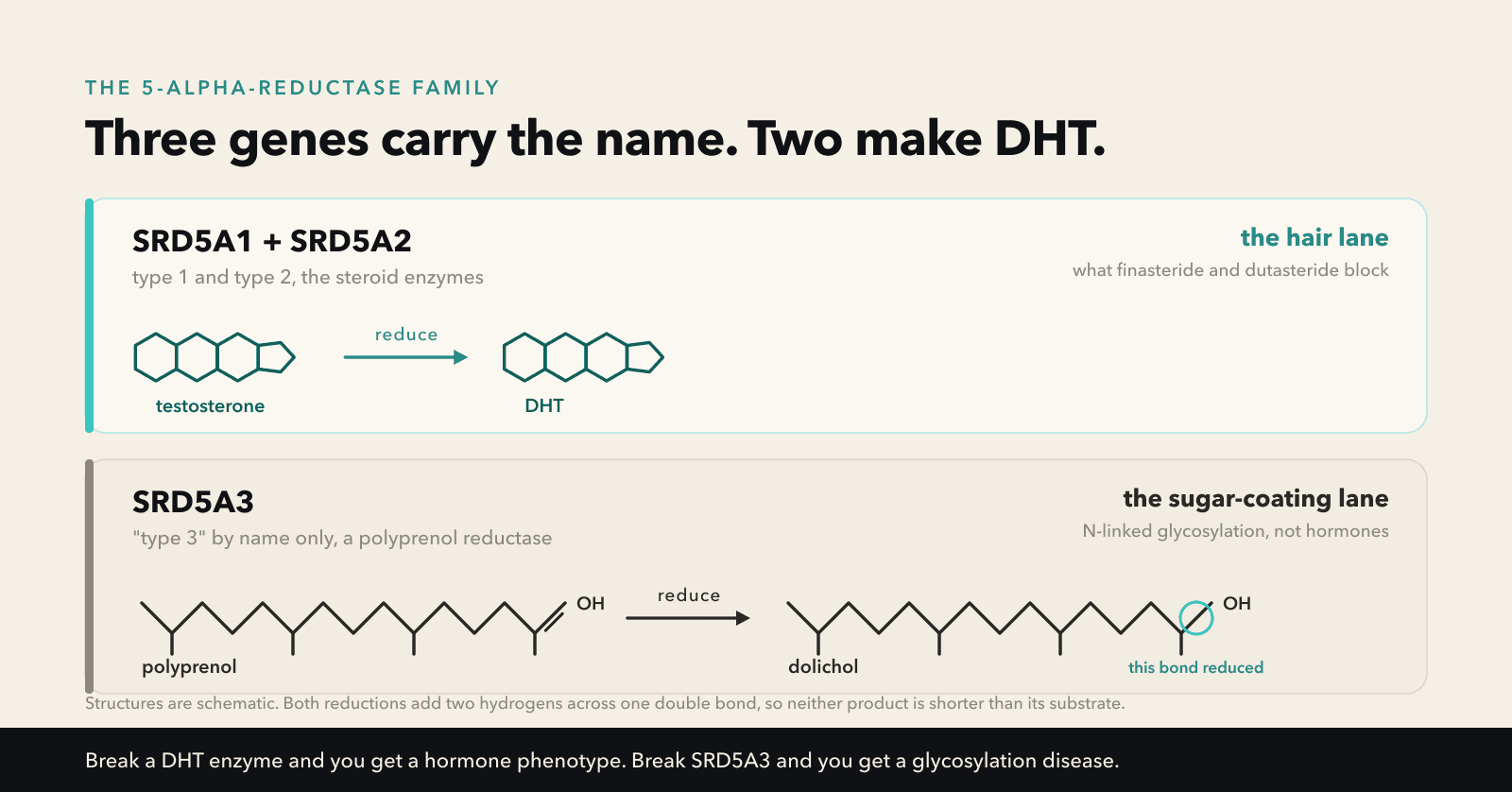
People say there are three 5-alpha-reductases. Only two make DHT. The third, SRD5A3, is really a polyprenol reductase in the sugar-coating pathway.
If you read about hair loss for long enough, you will hear that the body has three 5-alpha-reductase enzymes. That is true at the level of names, and misleading at the level of biology.
The short answer: There are three human genes named 5-alpha-reductase: SRD5A1, SRD5A2, and SRD5A3. Only the first two are the steroid enzymes that convert testosterone into DHT, the hormone at the center of male-pattern hair loss. SRD5A3 wears the family name because of sequence similarity and one early lab observation, but its real physiological job is different: it reduces polyprenol to dolichol, a carrier molecule in the pathway that coats proteins with sugar. When SRD5A3 is broken, people get a congenital disorder of glycosylation, not a DHT problem. So when you count "three 5-alpha-reductases," only types 1 and 2 are the DHT makers. The third is a misnomer.
Because three genes carry the label. The human genome has SRD5A1, SRD5A2, and SRD5A3 (Azzouni et al 2012).
The trouble is that a shared name implies a shared job, and here it does not. Types 1 and 2 are the well-established steroid enzymes. They take testosterone and add a pair of hydrogen atoms in a specific spot, producing dihydrotestosterone, or DHT. That reaction is the whole reason finasteride and dutasteride exist: both drugs block these enzymes to lower DHT. Type 3, SRD5A3, is a different animal that happened to land in the same naming bucket.
SRD5A3 is a polyprenol reductase. Its physiological job is in the sugar-coating pathway, not the sex-hormone pathway.
In plain language: many of your proteins are decorated with chains of sugar after they are built, a process called N-linked glycosylation. To attach those sugars, the cell needs a lipid carrier called dolichol, which works like a conveyor belt ferrying the sugar unit to the protein. Dolichol is built from a precursor called polyprenol, and the last step, turning polyprenol into usable dolichol, requires one reduction reaction.
That reduction is what SRD5A3 performs. In 2010, a team led by Vincent Cantagrel published the defining paper in Cell, titled "SRD5A3 Is Required for Converting Polyprenol to Dolichol and Is Mutated in a Congenital Glycosylation Disorder" (Cantagrel et al 2010). The title says it directly. The enzyme's real substrate is polyprenol, a long lipid chain, not a steroid.
Testosterone is a small four-ring steroid. Polyprenol is a long, floppy chain of isoprene units, chemically a completely different kind of molecule. SRD5A3's day job is reducing the second one, not the first.
Two reasons, both historical.
First, sequence. SRD5A3 was originally spotted because its gene sequence resembles the two real steroid reductases. When a new gene looks like a known family, it tends to inherit the family name before anyone has proven what it does. SRD5A3 was flagged as overexpressed in hormone-refractory prostate cancer and named the third member of the family on that basis (Uemura et al 2008).
Second, one early in-vitro observation, and it is worth reporting honestly rather than downplaying. The 2008 work found that, in an overexpression experiment, SRD5A3 converted testosterone toward DHT, and the authors described the activity as comparable to type 1 5-alpha-reductase, with knockdown reducing DHT production in the prostate cancer cell line they studied (Uemura et al 2008). That is a real measured result, and it is exactly why the gene got a 5-alpha-reductase name. But activity in an overexpression system is not the same as the enzyme performing that job physiologically. Two years later, the Cell paper established SRD5A3's genuine physiological substrate as polyprenol (Cantagrel et al 2010). The current understanding is that whatever steroid activity SRD5A3 shows in a dish, its physiological role is glycosylation, not androgen synthesis.
So the name reflects what the gene looked like and an early petri-dish result, not what the enzyme does for a living.
The cleanest evidence is what happens when SRD5A3 breaks.
If SRD5A3 were an important DHT-making enzyme, losing it should produce a hormone phenotype, something in the direction of what you see when DHT is low. It does not. When both copies of SRD5A3 carry loss-of-function mutations, the result is a congenital disorder of glycosylation, now called SRD5A3-CDG (Cantagrel et al 2010). The features come from proteins that are not properly sugar-coated: eye and brain involvement, developmental delay, and skin findings among them. Break the enzyme and you get a sugar-pathway disease, which is exactly what you would predict if its true job is making dolichol.
That is the logic that settles it. The steroid enzymes and the polyprenol enzyme fail in completely different directions, because they do completely different things.
We want to be precise rather than tidy, so here is the careful version.
Yes, an early study reported that SRD5A3 has some testosterone-reducing activity in vitro, and it was named a 5-alpha-reductase on that basis (Uemura et al 2008). But its established physiological role, defined by direct biochemistry and by human genetics, is reducing polyprenol to dolichol in the glycosylation pathway (Cantagrel et al 2010). And loss of the enzyme causes a glycosylation disease, not a DHT-deficiency picture, which is the strongest sign of what it is really for (Cantagrel et al 2010).
None of this means the early researchers were wrong to look. A gene that resembles the steroid reductases and showed steroid activity in a dish was a reasonable thing to name that way at first. The follow-up work reassigned the enzyme to its real pathway, and the name did not get updated to match. Biology is full of names that outlived their first hypothesis.
Because the whole DHT story in male-pattern hair loss runs through the type 1 and type 2 enzymes, not the third one.
Finasteride mainly targets type 2. Dutasteride targets both type 1 and type 2. That is why dutasteride tends to lower DHT more completely: it hits both of the real steroid reductases. SRD5A3 is not a meaningful part of this picture, and it is not a target you lower to reduce scalp DHT. If you see SRD5A3 discussed as "the third DHT enzyme" or as a hidden lever for hair loss, that is the misnomer doing its work.
The practical takeaway is a counting rule. When someone says there are three 5-alpha-reductases involved in DHT, the honest correction is: there are three genes with that name, but only two of them are the steroid enzymes that make DHT. The third belongs to the sugar-coating machinery, and it wandered into the family by way of its sequence and one early lab result.
At Anagen, this is the habit we try to bring to every enzyme and every number: not "what is it called?" but "what does it actually do, and how do we know?"
Not in any meaningful physiological way. An early in-vitro study reported some testosterone-reducing activity in an overexpression system (Uemura 2008), but SRD5A3's established job is reducing polyprenol to dolichol in the glycosylation pathway (Cantagrel 2010). The DHT that matters for hair loss is made by SRD5A1 and SRD5A2.
Two: type 1 (SRD5A1) and type 2 (SRD5A2). There is a third gene named SRD5A3, but it is functionally a polyprenol reductase, not a DHT-making steroid enzyme.
Because its gene sequence resembles the two real steroid reductases, and an early study reported testosterone-to-DHT activity in vitro, described as comparable to type 1, and named it the third family member on that basis (Uemura 2008). The name reflects sequence similarity and an early observation, not the enzyme's true physiological role.
People develop SRD5A3-CDG, a congenital disorder of glycosylation, because proteins are not properly coated with sugar (Cantagrel 2010). They do not develop a DHT-deficiency condition, which is the clearest sign that the enzyme's real job is glycosylation.
The clinically relevant targets of these drugs are the type 1 and type 2 enzymes, which make DHT. Finasteride is mainly a type 2 inhibitor and dutasteride inhibits both type 1 and type 2. SRD5A3 is not the point of these medicines, and it is not a hair-loss target.
There is no evidence for that. Its physiological substrate is polyprenol rather than testosterone (Cantagrel 2010), and the human phenotype from losing it is a glycosylation disorder rather than anything androgen-related. Claims that SRD5A3 is an untapped DHT lever rest on the name, not on the biology.
This article is educational and is not medical advice. It explains enzyme naming and biology, not the diagnosis or treatment of any condition, and it makes no claim about the efficacy or safety of any product or drug. Finasteride 1 mg is FDA-approved for male androgenetic alopecia; dutasteride is used off-label for hair loss in the United States. Talk to a qualified clinician about your own care.